Sunday, August 15, 2021

The Story of Tim- The Mighty Tusker of Amboseli

This is the story of Tim, the most famous African elephant in recent memory. He was the most impressive elephant I have ever encountered in the years of travels in the wilds, and will always be my favorite and most memorable.

Tim’s life began in the savannah’s and swamps of Amboseli National Park in Kenya, East Africa. He was estimated to be born in 1969, to the famous “T” family, which was this named and categorized by the iconic Dr Cynthia Moss and her elephant research team in Amboseli National Park. Hence the letter is given to this family, all members females and calves born to this family were given names with the letter “T”. This when Trista gave birth to a healthy male elephant in 1969 he was named Tim. His grandmother Teresia also had long straight tusks, and she bore another two big tuskers a male and female named Tolstoy and Theodora.


Over the years the genes of the T Family which results in large tusks showed clearly as he grew to become a fine young bull, and as he matured his ivory grew to its distinctive shape. One tusk almost touching the ground and the other curved inwards.


Tim in 2012 still maturing and growing


Thankfully poaching in Amboseli was quite low and hence he managed to survive until full maturity, and became one of the most dominant bulls in the eco system.

Despite this, he was well known as a crop raider and used to rain many of the plantations and farms outside the protected park boundary. In 2014 he was treated to a bad injury in the rump by a spear.

In 2016 he was seen with a spear sticking out of his head, and knowing there was relative safety in the park he was seen walking around with this injury until he was subsequently treated. 


Tim with a spear sticking out of his head


Tim being treated for a spear wound

In September of the same year, the park decided to radio collar him in order to help keep track of him and his movements and hopefully avoid further issues.


Tim being darted and tranquilized to fit a radio collar on him


Tim with his new radio collar


But this did not stop him, and around 2018 he broke his collar. He continues to get into mis-haps and near death experiences it seems as once again in December 2018 he got stuck in deep mud in the Kimana swamp. The rangers of the Big Life Foundation were alerted and a herculean operation ensued where he was pulled by a tractor with multiple breakages of the straps, to gradually pull him over 25m over muddy terrain to finally enable him to gain a firm footing at the last light of day, and avert a disaster.


Tim stuck in the mud


Tim stuck in the mud


He was often found outside the park itself mostly in nearby surrounding conservancies and forest patches during the day, usually accompanied by a large group of young males who follow him. Sometimes his relative and “uncle” Tolstoy was also seen with him and when I visited in 2019 his lookalike Craig who had similar tusk shapes albeit slightly smaller was with him. The rangers have a daily task of chasing him and the others back to safety as they end up raiding many of the crops in the local farms, eating the fresh product like tomatoes. This would en-rage the villagers and the fear was always there for retaliatory action against Tim.

Sadly and shockingly, Tim died in February 2020, apparently due to natural causes which were said to be a twisted gut. But the question remains if the multiple tranquilizers used to sedate him for different purposes over the years took a toll on his health. Nevertheless he was gone to us, and it came as an absolute shock to many around the world. Tim had managed to capture the minds and hearts of thousands of people the world over.

His tusks were massive and once extracted and weighed were a an astounding 71 KG and 68KG each. If he had survived a few years longer, his tusks might have even reached 80KG. 


My memories with him will remain forever engraved in my heart. From my first quest to see him in 2016, and how I finally saw him on the final day of our tour. I still remember my adrenaline pumping hours after our encounter. It was like nothing I could have imagined. My life’s dream of photographing a big tusker of Africa became a reality.


Then three years later, I once again met him face to face outside the park, this time much closer and on foot. Spending over 3 hours with him and his companion Craig, it was truly an unforgettable experience. Sadly I never realized that this would be the last time we see each other again as he died the next year a week before we were to leave for Kenya to try and see him again.


The memory and legacy of Tim will last forever and he will always be the gentle giant of my heart. 

Tuesday, May 25, 2021

Sri Lanka's top 5 places to see Leopards

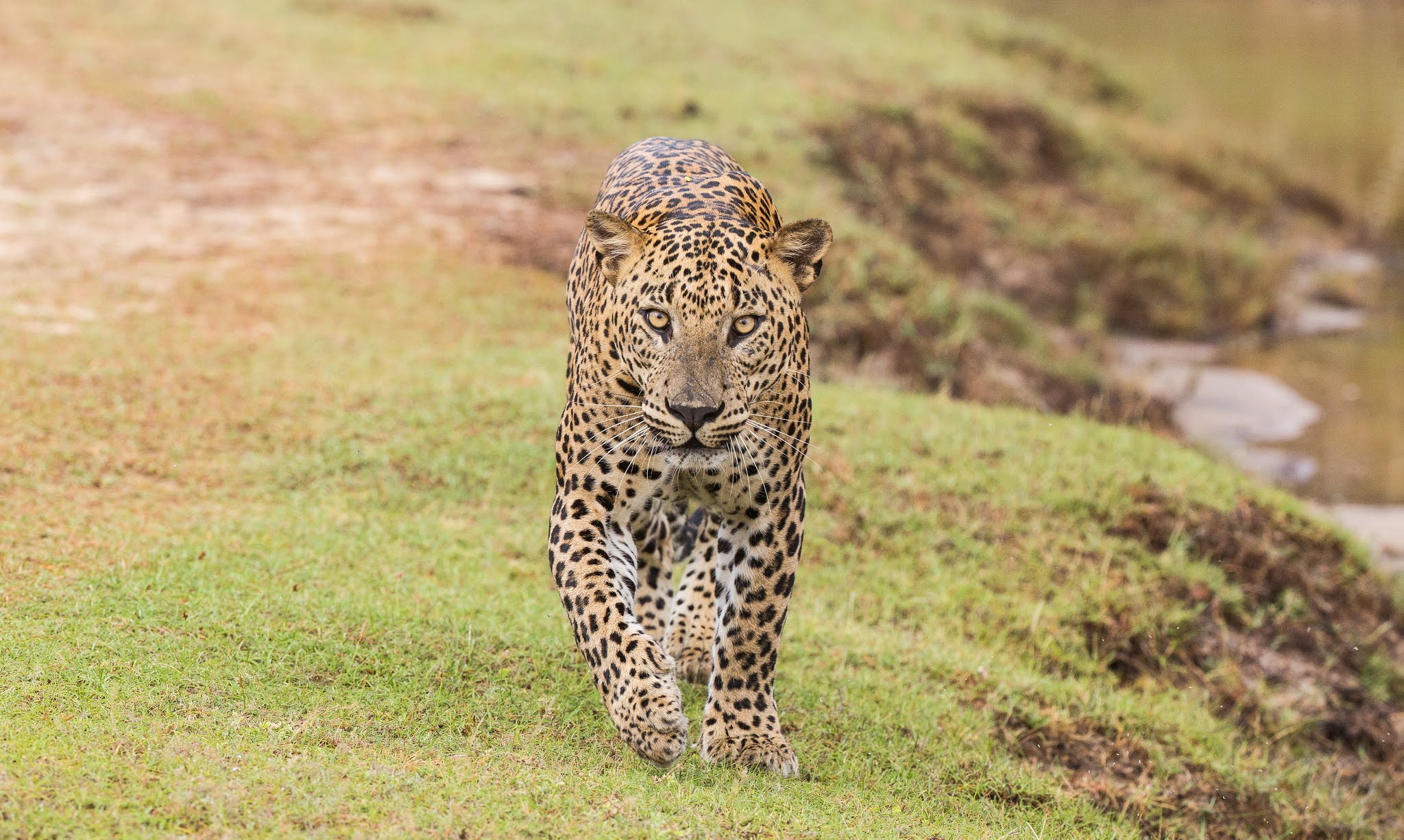
Sri Lanka undoubtedly is the land of the leopard. This is one of the few places in the world where the leopard can claim the moniker of the apex predator of the wilderness. In other continents and countries such as India or Africa, the leopard needs to compete with larger and more formidable predators such as lions, tigers, and even Hyenas in the case of Africa.

In Sri Lanka, there is no such predator to compete with the leopard. The occasional scuffle with a wild boar and a sloth bear has been known to occur, but overall the leopards are free to hunt and feed unabated.

This level of freedom has further enabled some of the best daytime sightings of these magnificent predators on the island. Being the top predator in its habitat the leopards are more confident and can be seen out in the open, completely relaxed.

The Sri Lanka Leopard is a unique subspecies that is native to this island. They are also the largest subspecies along with the Iranian Leopard. For a trained eye, one can easily spot the difference between for example an African Leopard and a Sri Lankan Leopard. The facial structure and coloration are the key differentiators.

Hence for anyone who is keen on covering as many species and subspecies as possible, it is important to visit Sri Lanka and try and photograph and see the Sri Lankan Leopard.

That being the case, the question would arise which is the best place to see leopards in Sri Lanka?

This is a worthy question as Leopards are found in many parts of the island, but they are not seen as well in all places, especially in areas where they are not habituated.

This too is important as habituation to humans and vehicles is key in having great leopard sightings.

From decades of observation and hours spent in the field here are my top 5 places to see leopards in Sri Lanka


#1 – Yala National Park (Block 1)

Undoubtedly the top spot has to go to Yala National Park, the crown jewel of safari parks in the country. This is truly the land of the leopard, with some of the highest if not the highest densities of these amazing predators in the world. The sightings of a beautiful cat walking across the open plains or atop a rocky outcrop is a signature sight in Yala National Park. There are many famous leopards that have become household names in Yala. In the past big males such as the “Chaitya Male” (known to have been big and strong enough to bring down an adult buffalo) and Hamu was iconic. At present, a very detailed study on the leopards of the park are being carried out whereby over 130 individual leopards have been identified. Even now, new individuals keen getting identified, which showcases the vast density of these predators in such as small area which is only 142 Square Kilometers. Some of the notable characters during the present era to emerge from Yala are – Lucas, Julius, Harak Hora, and Aster to name a few. A very informative “Leopard Center” is present in the park where visitors can learn more about these predators and also compare one’s own sightings with the virtual database and try and identify the leopards they have spotted while on safari.


#2- Wilpattu National Park

The land of lakes, Wilpattu is located on the North-Western end of the island. This is Sri Lanka’s largest national park and is quite a contrast to the landscape of Yala. Where Yala is mostly dry scrub forest, open lagoons, and plains, as well as many rocky outcrops, Wilpattu is denser with dark forests being the dominant landscape, along with few open spaces which are usually consisting of natural lakes known as Villus. The dense dark forests make it quite difficult to see these predators, but when they do come onto the roads it is a sight to behold. The open sand-brimmed lakes are some of the most beautiful settings to view these magnificent predators. The park was closed for many years during the time of the civil war and was finally opened to the public in 2010. During this time, the leopards were very shy and sightings were almost nonexistent. But over time, after a few years of continuous visitation, the leopards gradually became habituated enough to give some great sightings. Through the years, Wilpattu has become increasingly popular, especially with wildlife purists who seek more private and quieter moments compared to Yala which can tend to be congested and crowded. The chances of seeking leopards in Wilpattu is somewhat harder than Yala, but usually, the reward of the sighting is far greater most of the time due to the lower numbers in the park and the ability to spread out across the landscape given the size of the park. One of the most photographed leopards from back in the day was the infamous “Prince” a.k.a “Natta” who was a young male leopard who was born in the Kompanchi Sampuwal/Pomparippu area and later moved around to many parts of the park. He was at one time the most photographed leopard in Sri Lanka, giving shows like no other, often sleeping in the middle of the road paying no need to the on-looking people and vehicles. He was named Natta due to the fact that the end of his tail fell off due to an injury probably with a wild boar or another leopard. He is still alive but has been driven out to the fringes of the park by larger and more dominant males. One of the most famous and well-loved males of the park is the Nelum Wila Male, a massive individual who has a large home range and is seen quite often walking without fear of people. He is the current star of the park and one who literally poses for the photograph. When it comes to the female’s one of the most beloved leopards has to be “Cleopatra” the beautiful female who was known as a playful cub from Borupanwila. Now a successful mother with her own brood of cubs is seen by lucky visitors mostly in the Mahapatessa area with her cubs.


#3 Kumana National Park


Kumana, the land of mystery and awe is located on the far eastern corner of the island. In fact, it is connected to Yala and is part of the same ecosystem. But due to the access and location, it is quite a long drive to reach compared to Yala. Kumana was initially famous as a bird sanctuary with many species of birds nesting in the waters of Kumana Villu. But in the last decade or so, there has been an increasing number of leopard sightings in the park. The legends say the leopards of Kumana are known “man-eaters” and the leopards of Lenama (an area in the park) are mythically known to be larger and deadlier. But the reality is that these too are the same leopards that you see in Yala. But there have been cases of man-eaters in the park which are more than in many other parts of the island. In 2019 a construction worker was taken and eaten by a large male, who subsequently attacked and severely injured another individual who went to retrieve the body of the victim. Thereafter in 2020, another leopard attacked a farmer in the nearby area of Panama while sleeping in his watch hut. The man succumbed to his injuries. The same leopard thereafter attacked a few men on patrol at night in the fringes of their farms. The authorities managed to capture the culprit who was released deep inside the park which caused much controversy.

Despite these individual cases, the number of sightings of leopards is increasing as the animals become more habituated. The advantage of seeing leopards in Kumana is the privacy and lack of large crowds. Given the remoteness and difficulty to get to the park has resulted in making this one of Sri Lanka’s best-kept secrets.


#4 Veheragala (Yala Block 5)


Veheragala National Park also known as Yala Block 5 became popular in the last 6 years as an alternative to Yala Block 5. The small land extends borders the giant Veheragala reservoir and is less visited than its more famous counterpart. This park is also known for its fair number of leopards, often seen on the main road which runs through the park. The high density of prey animals such as Spotted Deer and Grey Langur may have resulted in the number of leopards seen, and gradual habituation has helped greatly in giving quality sightings. This is a great park to combine with when visiting Block 1 in order to get away from crowds and to get a change in landscape.


#5 Horton Plains National Park


The misty highlands of Sri Lanka is hardly a place one would imagine encountering a leopard but despite this, historically the highlands was where most of the islands forest cover was and where most of the wildlife animals roamed. With the onset of the British taking over the country, they cleared these vast forests, to grow Coffee and subsequently Tea.

One of the last remaining highland wilderness refuges is Horton Plains, National Park. Located over 2500 meters above sea level this montane wilderness is set atop a high plateau and is one of Mother Nature’s spectacular wonders.

Once even used by the government at the time to grow potatoes, it was later declared a National Park and a UNESCO World Heritage Site.

This land is one of the most sensitive and ecologically important locations in the country with a vast number of plant and animal life endemic and found nowhere else in the world.

The park was very popular for its scenic landscapes and walking trails. Subsequently was highly valued as a top birding destination to see some of the rare highland endemic species.

In the last few years, through countless visits and patience, this too has produced some unforgettable leopard encounters.

The kings of this domain, these predators are found in the deep dense cloud forests and on the fringes of the open plains which are the main landscapes of this habitat.

Feeding primarily on Sambhur the largest species of deer in Sri Lanka these cats seem to have a few physiological differences to their lowland cousins. The Horton Plains Leopards seem to be much larger in physical size and their faces wider with shorter muzzle areas giving them a stouter and wider look.

A study carried out by a a scientific team consisting of Dr Enoka Kudavidanage in 2020 has identified 23 adult leopards found in the park.

Seeing these majestic predators is much harder than in the lowlands but with a trained eye and patience you might have a chance in getting a glimpse of these highland beauties.  


The last stand of the Tuskers of Sri Lanka

 What is a tusker and why are they so special in Sri Lanka? This is a question many people asked me over the years. The truth is that no only the fact that only 7% of the male elephants in Sri Lanka carries tusks, which makes them so rare and special, but the aura and behavior of a tusker are so much more special. They are the true monarchs of the wilds of Lanka. When a tusker comes out into the open and joins a grazing herd of elephants, you feel his presence. They are the “rockstars” of elephant society. The most desirable male for receptive females to mate with, the most intimidating rival for other male elephants.

The tale of tuskers of Sri Lanka can date back several thousand years. The mainland of Asia once connected to our island via a land bridge has its own sub-species of elephants. Historically scientific evidence states that 97% of males are supposed to carry ivory. Hence it was the norm in the Asian Elephant (Elephas Maximus) males to have tusks. Then the question arises what happened to Sri Lanka? Why is there less than 7% of the male population having this genetic trait? There are several theories being debated among scientists and pundits alike.

The most logical explanation for this is that through thousands of years, starting from our kings of old, the best tuskers the prime bulls of any herd were targeted for domestication, and even to import. Ancient texts state that Sri Lanka “exported” elephants to other countries, due to the fact that Sri Lankan elephants were prized for their size and strength. Thereafter the three colonizers, the Portuguese, Dutch, and finally the English managed to systematically target and decimate the existing population. The first targets of any hunt were the tuskers, the prime breeding bulls of elephant society.

Within a few hundred years, we are left with a dwindling populace of these once mighty specimens. Estimates can round up the current population of wild tuskers at around 120-180 animals at most. That being said this number is being reduced every year.

Though poaching is an imminent threat and many tuskers did fall to the guns of the poacher, the primary culprit for the decimation of tuskers and elephants, in general, is habitat loss and the human-elephant conflict that results from this.

There is an estimated 6000 plus elephants on the island as per the last census carried out in 2011. Sri Lanka also is shamed to have the largest number of elephant deaths for 2020, with a staggering 318, and a shocking 407 in 2019. This would easily outnumber the number of new elephant births, and also the death toll needs to add the numbers which are not recorded, and hence we have a scenario where the overall populace is facing a gradual reduction. The lack of viable habitats for these giants and the current lack of a credible wildlife management policy will result in mass starvations and a sudden plummet in numbers in the coming years.


There are plans and talks underway to “conveniently” drive all the elephants outside national parks to the said parks, be it Wilpattu or Udawalawe or sanctuaries like Kahallapallekele and lock the elephants up so they can escape. This naïve and impractical move has been discussed by many of those in power for countless regimes without a proper understanding of the elephant's actual requirements and needs.


1-      Each land area has an ideal carrying capacity for elephants. The common misconception most laymen (who are virtually most of the policymakers and whose in power) is that there are many trees in the forest hence why can't they eat the trees. The reality is that elephants require a vast range of disturbed forest and grazing land. This is the only way it can sustain a 3-5 Ton animal. Elephants eat up to 150 KG of vegetation daily, and densely forested areas cannot provide enough nutrients, especially for a sudden surge of more elephants pushed there with an elephant drive. The classic case of such a disaster was in Lunugamvehera in 2006. The Department of Wildlife Conservation drove around 260 elephants into the Lunugamvehera National Park. The tragic result is that most of them, mainly the females and calves died of starvation. Thus we are about to face such a disastrous move very soon as per the current directive it seems the policymakers are about to drive a mass extinction of elephant using the “Elephant Drive” ploy.


2-      Vital migration paths such as the Dahaiyagala Sanctuary have been cleared and given to people for agriculture. The current state of the elephants in Udawalawe , which is a vital Tourism attraction is that they are unable or hindered to move out of the park to their traditional regions such as Bogahapattiya due to this. Further adding to their suffering the growth of an invasive plant known as Lantana or Gandhapana in Sinhalese (which the elephant doesn’t eat) have resulted in emaciated and malnourished elephants in the park. With quite a few deaths of newborn calves. Udawalawe generates much-needed revenue and employment to many people in the region and yet there seems to be no interest by the powers that be to look into this situation.

3-      One of the regions with the highest density of tuskers in Sri Lanka is the Galgamuwa region. Despite being home to over 350 elephants, there are no large national parks or sanctuaries nearby. For many years the elephants survived by moving from small forest patch to forest patch , and continuously being harassed and in conflict with local villagers and their cultivations. Many notable tuskers emerged from this region, out of which two exceptional individuals the SIyambalangamuwa Tusker also known as Parakrama died due to a failed attempt to translocate him and the other is the Dala Puttuwa or Crossed Tusker who fell to the poacher's bullet. Both their lives ended tragically, and many surviving tuskers carry the scars of their turbulent lives in festering gunshot wounds all across their body.

The latest debacle faced by the elephants of Galgamuwa is the clearing of forest land in Nakolagane bordering the Palukadawala Reservoir. This is the last refuge remaining for these 350 plus elephants in this entire region. Mostly spending several months in the forest and coming to the lakeshore to graze and drink water. The Chief priest of Nakolagane Rajamaha Viharaya is carrying out a project destroying the forest using bulldozers and using this forest land to grow traditional rice varieties.

This disastrous move will not only deny the elephants a place of refuge but will also increase the conflicts will the villagers as the elephants will invariably move into human cultivations and homes as their habitat is destroyed.

It is shameful that despite the teachings of Buddhism preaches kindness and care to all life forms that those who claim to be representatives of the faith are destroying the very fundamentals of the said philosophy.

If the citizens of Sri Lanka from villagers to urban folk don’t band together and demand a workable solution to this eternal conflict and destruction of forest habitat, this massive Ecocide will have ripple effects that will affect this island nation for generations to come.

Sunday, April 5, 2020

Leopard in Udawalawe

Around 7 years ago , I got news of a female leopard with some cubs being sighted in Udawalawe National Park. This park is more famous for its elephants, and seeing a leopard is an absolute rarity. The chance of seeing one would be a great opportunity, and hence myself and my friend Hamid decided to go on a day trip to the park early morning and try our luck.

We decided to drive into the park in Hamid's pickup rather than hiring a jeep. We set into the park early morning with some packed breakfast. We reached the rocky outcrop where the leopards were said to be sighted. It was a very tough place to spot anything as besides the rock, the surroundings were covered in 6-7 foot tall elephant grass. Hence we had to focus solely on the rock.

Waiting hours, we had no sighting whatsoever. We decided to head back out as the sun was getting quite hot, and have some lunch before returning back.

Back in the evening, we waited for a very long time circling the rock, and looking at all possible directions for a sighting. While doing the circle, suddenly one vehicle up front said the leopard just crossed the road from the side of the rock to the other side , into the tall grass.


We drove past where the alleged crossing had occurred and waited. Suddenly Hamid spotted the leopard peering from the edge of the grass from his rear view mirror. As we had no time to turn around I opened the door slightly and put my lens out. I caught a glimpse of the leopard hiding in the grass. The angle which I was turning aroound and holding the heavy lens gave me a massive cramp on my torse, but I gritted my teeth and waited , expecting it to cross the road.


But before I could even click my camera the young leopard dashed across like Grease Lighting !

Back in the car, I was wincing in pain from the cramp, and checked my camera thereafter. I had managed to catch only one shot of the cat peering through the bush, the crossing was too fast. But I was not upset as I was very happy in seeing a leopard finally in Udawalawe which is one of the rarest sightings one could get.


Saturday, April 4, 2020

Road Trip with my Dad

I had just graduated from my degree, and I was aimless at home. I was looking out for jobs, but there were few and far between.

My father told me he is going to Yala with one of his closest friends Uncle Stefan, and I jumped at the idea and asked if I could tag along.

The journey began from Colombo, and we headed firstly towards Galle. This was 2009, and there was no Southern Expressway, hence we took the good old Galle Road.

We spent 2 nights in Galle at the light house hotel, and we visited some friends of Uncle Stefan along the way.

Thereafter we set off to Yala. I was very excited as I hadnt been out to the wilds in quite some time due to the work in University. Reaching Tissamaharama we filled up the coolbox with crushed ice and with a box full of chilled beer and provisions we set off to Yala.

Our stay was in Nimalawa, just outside the park, and we dropped our bags, and headed into the park with our trusty jeep driver at the time Jagath.

Jagath decided to turn into the Welmalkema Road, and passing the main Kema area we came across a decomposing carcass of a Sambhur kill. Driving a little ahead we came across a leopard on the rocks. This is the first time I moved to a DSLR for photography as I borrowed my father's Canon 350D with a Tamron lens to try and get some photographs. It was too late in the evening and the photographs did not come out as desired. Nevertheless I was happy at the sighting of the leopard peeping from the rocks as a large wild boar passed by. After a few minutes the cat moved back into the rocks.

We turned our jeep around and came back to the kill, and noticed its been moved to a different location. This signified none other than the fact that a second leopard has moved the carcass while we were gone.

We decided to wait for some time at the carcass. It was quite difficult given the overwhelming stench, but we stomached it and waited. All the other jeeps decided to move off, and we remained. After over an hour of waiting, it paid off, when the leopard crossed the path in front of us and moved to the carcass. Given the level of decomposition it was doubtful the leopard was able to find anything to eat in the dead Sambhur which was mostly skin and bones by then. Nevertheless I kept on clicking and was delighted with this sighting. After it has had its fill the leopard crossed teh road and walked deep into the bush.


I was elated at the sighting and happy that my father and Uncle Stef were able to witness it as well.

The next day, we returned to the site, but had no luck, and we continued on our search. We came across the usual wildlife in Yala which was amazing from elephants, to crocodiles to a vast array of birds.

In the evening we returned to Welmalkema and came across a large male who walked across the rocks near the Kema (rock pool).


On our final morning safari, we decided to make a change and headed towards Bundala. We didn't see much wildlife but were happy to have a change of landscape and witness a park I handn't visited since my school days. We did come across a massive bull elephant who was prone to charging vehicles, and we did get abit worried at one time when Jagath had trouble starting the engine, but finally managed to do so and escape in the nick of time.

A great trip, and one of the first "post school" trips which began a new series of adventures for me.


Jungle Cats of Udawalawe

The Jungle Cat, one of the most elusive and rare felines found on the island. Very few people are even aware of its existence, and yet they are found in most parts of rural Sri Lanka.

At first glance , you might mistake it for a normal house cat, but looking closer you will notice, its taller and long legged, as well as having a uniform sandy, reddish brown fur. and noticeable ear tufts which are not seen in regular house cats.

Very keen to see this rare cat during daytime, I was advised to head to Udawalawe to try my luck. With this in mind I made plans to visit with my friends Sapumal and Madhawa.

I managed to get the services of a very experienced tracker in Lionel and a superb jeep driver in Sanath to help us in our search. They were not full optimistic, but said we will try nevertheless.

Heading to the Maw Ara area we were on the lookout for any signs of the cats. Lionel taught me to look out for the chirping of birds in alarm, which is usually the signal the cat is around. Similar to the alarm calls we usually hear from the Spotted Deer and Grey Langur for the presence of a Leopard, in this case we had to wait and listen to the small birds.

As advised, we noticed the sudden flock alarm calls, and we waited. It took an eternity but our driver and tracker both advised us to be patient. And as predicted about an hour later, out came an adult Jungle Cat and her kitten. They were so fast and going in an out of the reeds and bushes, I could not get a clear shot. Before I knew it, they were gone.

Sad about missing the photograph, but happy at the same time in finally catching a glimpse of these beautiful cats, I was determined to try and find one the next morning.

Setting back into the park the next day we scoured the area and could not get any luck in spotting a cat, until mid day, when we were about to head back out, we came across a cat walking along the road in front of us. It was quite a distance away and we did not want to alarm it so we kept our distance and followed. The cat kept walking along the jeep trail and kept looking back at us, before slipping into the tall reeds and dissapearing out of sight. Sadly this time around as well I missed getting a photograph.

Few months later, I was determined to return back to the park and try again. This time I was alone, and went with my chauffer Sampath. On the first day into the park, we saw no cats, but rather many elephants. The next day morning, we headed back in early as possible, and came across a cat which slipped into the bush, but managed to look back at me for a few seconds before dissapearing.


We stopped on the road side for breakfast, and waited. The sun was blazing by this time and we decided to head back out. While driving along, Sampath told me he saw something sleeping underneath a bush. Skeptical I asked Sanath the jeep driver to reverse back. To my surprise it was a jungle cat, fast asleep in the shade. We waited and enjoyed our private time with this feline in slumber. Suddenly an approaching jeep's racing engine work the startled cat, who gave as a look for a few seconds before slipping back in to the bush, but gave me enough time for some photographs.


Elated, I left the park knowing how special and rare a daytime sighting of this predominantly nocturnal cat is'.


Memories- My first visit to Yala National Park


Yala or Ruhunu National Park is the most famous Safari destination in Sri Lanka. The park was out of bounds for a few years due to a terrorist attack in 1996, therefore even after Yala was re opened to the public the school did not want take any risks by taking young school chindren into a place with another possible terrorist threat. I had heard so many stories about Yala, and had seen many old black and white photographs of my mothers trip to the park. Finally during the April holidays of 2000, I was able to go to park which I have heard so much about. For me, this was a big step up from what I was used to. The parks I used to visit at the time, Wasgamuwa, Udawalawe and Bundala all had elephants, but we hardly saw other animals. Even the deer were very shy in these other parks, thus it was a big surprise for me to see so many spotted deer in such close proximity, and being so used to vehicles. It was also the first time I saw wild boar.


We camped at Jamburagala Camp Site, which had a small cement structure, thus not requiring tents. Water was supplied by a well some distance away for water. We were strictly instructed not to go to the well alone as the place was next to some rocky outcrops which were frequented by bears. I remember the well being very stale and the water was very brackish with small shrimp like crustaceans floating on the surface. That evening at around 10.00 PM we heard the unmistakable rumble of an elephant very close to the camp site. Mr. Rohan one of our school masters who joined us on the trip was sleeping in the jeep closest to the elephant. Nirmal Sir had warned us of the phobia Mr Rohan had of elephants. I slowly woke him and whispered that there is an elephant close by. He yelped in fright and scrambled from the back seat into the front seat of the jeep, and from there made a hasty retreat towards the building. The elephant clearly frightened by the noise went on it way. We were in fits of laughter, as Mr. Rohan on other occasions was a very tough individual.


The next day morning we were driving along Uraniya road, and while taking a bend came face to face with a tusker. This was my first tusker in the wild and I was extremely excited. This tusker was named Anuradha and I couldn’t believe my luck, a tusker on my first park round in Yala. We had a face off for a few minutes, and then the tusker went on its way into the bush. Still buzzing with excitement from the encounter I had a hearty breakfast and worked on the camp chores till evening. In the evening round while heading back to the campsite from an uneventful safari I encountered my first leopard on the middle of the road in Jaburagala. It was a large male, and after snarling at the lights of the jeep (it was pitch dark), it started walking along the road, and we followed it, for some distance before it slunk into the darkness of the forest. I was beyond words by then a tusker and leopard in one day was something I could never have imagined back then.  


That night we were all in a jubilant mood, and Nirmal sir seemed to be a little at ease as well , and allowed us to bathe at the well for a little longer than normally allowed. I was given a small camp bed by my friend Bimantha, and I remember it being so flimsy that it would collapse down if I moved too much, and I slept very carefully because Rohan Uncle was sleeping on the floor next to me and as he was very irritable I did not want to upset him. I slept soundly and in the morning I tried to slowly get off the bed and  quietly step over the sleeping Rohan Uncle, but suddenly the bed gave way and  it collapsed with Rohan Uncle underneath. I believe he would have had the shock of his life and the bed with all my weight fell on top of him. I swiftly jumped off him and darted out to the open before he could catch me. I heard him loudly cursing back at the scene of the incident, and I hid from him for the rest of the day.


The next few days we saw one more tusker on the main road. Its name was Kublai Khan after the great Mongol Emperor. It gave a small mock charge and thereafter remained on the road for more than 30 minutes, so we turned back and headed the other direction. We also took part in a small project where we put up sign boards along the Palatupana road warning vehicles of crossing animals and urging them to slow down. This was due to a request made by the park warden as many animals, especially small ones such as monitor lizards and black naped hare, were being run down. We were also given a lecture about the park by one of the senior rangers who visited our campsite. Back then I maintained a field book with notes on all my sightings, and learning’s from each trip.


My first visit to Yala will never be forgotten and will be the first of many visits to this amazing park.

Memories-My First Camping Trip in the Wilds


I will never forget the first meeting of the Wildlife Society which I attended in 1997.  I was the youngest member, and all the other boys were seniors in their late teens. This did not hold me back and I signed up for the first trip of the year, which was a 5 day camping excursion to Udawalawe. The cost was very minimal back then, and the charge per head was around 400 Rupees.  The master in charge Mr. Nirmal Fernando also known as “A.E.N Sir” due to his initials was a very tough character and I was mortally afraid of him as he was our caning master in school, and I had received quite a few lashings in my first term at College. Nirmal Sir in the future years became a very close mentor of mine, and even to this day is like a father to me.


The plan for the trip was that we assemble in front of the College gate at 4.00 AM in the morning. My mother had to dive me there, and brought along Nishantha one of my neighbors as a chaperone as she would have to drive back alone in the dark, as my father was overseas on work. I remember it was a very organized affair, and there were around four jeeps in total, all provided by one of the parents of the boys named Rohan Kulatunga, who we called Rohan Uncle, who would play a big role in most of my jungle adventures in the coming years. We departed at around 5.00 AM, and I was put in a jeep along with all the other junior members, Daham, Bimantha and my cousin Dilsiri. I was the only fresher as the others had gone on trips before me, and I had a mixed feeling of excitement and nervousness. This is the first time I was off on my own without my parents and my mother ensured that I had everything I needed, from food, to a complete list of clothes and toiletries. I remember my mother was worried about mosquitoes and ensured that I take a dose of quinine as well as a full stock of repellent. She had packed her famous home made pizzas for my breakfast, and as soon as the seniors got a whiff of it, it disappeared before I could even have a bite. The ride seemed long and tiring, reason being that the roads weren’t as good as they are now, and also because these jeeps were old land rovers and land cruisers and were not made for comfort, but I did not mind, the adventure was something I was looking forward to for a very long time. We reached the park entrance by noon, and headed towards our campsite, Alimankada (Elephant Pass). I was tremendously excited about the fact that we were camping next to a river.  But I did not have time to be idling as there was lots of work to do, as 30 of us got together to set up the campsite and prepare lunch. After a good meal we had a nice cool dip in the river, but Nirmal Sir did not let me go too far as he was responsible for my safety and thus kept me close to the riverbank. The evening game drive was not that eventful and I cannot recall any sightings of elephants. 


Back at the campsite, I had a major dilemma. I need to answer the call of nature, but as I had never been in the outdoors, I was very uncomfortable of going the bush to relieve myself. I asked the cook Ranji to accompany me, and I still remember me being very embarrassed that I had to go out in the open where everyone can see me.  In the night we all gathered around the campfire, and Nirmal Sir, Rohan Uncle and the seniors shared with us their experiences and knowledge about the wild. I was allocated to a tent where all the juniors slept. It was very uncomfortable I remember, because it was raining and the tent was leaking from certain areas, and the heat was pretty unbearable.

In the morning we had a nasty surprise, someone had left some fried “papadam” underneath a jeep at night, and entire army of “kadiya’s” had invaded the campsite. There were literally millions of these soldier ants whose bite was very painful and they were all over the campsite and despite the efforts of using Kerosene oil, we were left with no choice but to move camp. 

The new campsite was called Pansadara, which was a much larger and we had more room to spread out our tents.  During the evening I witnessed my first herd of wild elephants.  I also recall an encounter with two big bulls that had a brief face off before engaging in a short duel. I noticed that many of the boys had cameras with them, and I was longing for one of my own, to capture all these memories. This yearning is what made me try my hand at photography many years later.


 The following days got me accustomed to the rhythm of the jungle life, I learnt many camp chores such as how to pitch a tent, how to clean vegetables for the kitchen, and how to light and clean a hurricane lantern. These and many more skills have helped me take on any problem and hardship in life. I will always remember this first venture into the jungles of Sri Lanka, as it not only gave me the first taste of the wilderness, but it made me who I am today.


Friday, April 3, 2020

My Experience with Leopards of Horton Plains


Horton Plains is a place which is close to my heart and arguably would be my favorite place in the world. The land of mist and rain, of rolling green hills and dark cold forests. This is one place which always held a mystery with it, and an emotion hard to describe. I have been travelling to this park since I was very young, and in-fact my family have taken me even as a 3 month old infant on the regular trails of this beautiful park. But very few have truly attempted to catch a glimpse of its unique wildlife up close and spend time focusing on finding the rare, elusive and endemic until recently. Few people are aware that the park has a thriving leopard population, as very few are lucky enough to catch a glimpse of these elusive predators.

Hence determined to see one, myself and my friend Hamid made our way one March to spend 3 days in the park in the hopes of photographing a leopard. We had booked the Maha Eliya Bungalow which is located right in the heart of the plains and a good launching pad for our search.On the first night itself we had our first encounter, as Hamid went out to where he has parked his pick-up truck to charge his phone and suddenly noticed a large male leopard seated in front of the car watching him. When he turned his flashlight the leopard had disappeared into the darkness. Skeptical of this I went ahead on the path in front of the bungalow to check for tracks and noticed the pugmarks confirming the incident. The next day we were up early and set off on our drives along the park main road from the bungalow all the way to the Pattipola Entrance gate, and then back towards the Park Office and to the Ohiya Entrance Gate. This is known as the best stretch of road where leopards have been seen. The mornings were bitterly cold and very misty hence we found it tough to get a good view, but we heard a few alarm calls of Sambhur who are the leopards main prey but didn’t get any sightings.

That evening, we were driving around, and the weather was great with no mist and good light. We were driving towards the Park Office, and were observing how good the light was on the left side of our vehicle where there was a wide open valley, when something caught Hamid’s eye on the right. It was a leopard sitting by the roadside just watching us pass by. He hit the brakes pretty hard and I went flying forward as I was not wearing a belt at the time. In Hamid’s excitement he accidently pressed the horn while trying to take out his camera, and the shy cat walked into the bush. But it wasn’t particularly alarmed as it walked away calmly. We waited at that spot, scanning the area for a very long time, but to no avail, and hence turned back and was heading towards our bungalow when we heard some Sambhur alarm calls ahead, and when we drove to the spot we observed the directions the herd of Sambhur were looking at and out came this gigantic male leopard. It was easily the biggest leopard I had ever encountered, and the color was a beautiful golden yellow. The leopard was quite a distance away on an opposite hillock and was walking away from us. I managed to capture two blurry images of the cat as it moved out of sight. We were in disbelief, our first sightings of leopards in Horton Plains, and how magnificent they were.


The next day was uneventful, but on our last morning drive, while driving towards Arrenga Pool from the Maha Eliya side, there comes an opening where there is a valley on the right which extends all the way to the Thotupola Kanda forest tree line, and immediately as we reached there, Hamid with is amazing eye sight spotted a big leopard peeping from the forest edge, but took some time to maneuver his pick-up truck to the side of the road by which time the leopard once again slid back into the dark forest. We were kicking ourselves and thinking what an amazing shot it would have been, when the leopard once again came out, and this time I had made a fatal error in sitting on the passenger side on the left, hence I had to get down from the vehicle to get a clear shot. By the time I did that, I missed the shot again. Thankfully Hamid had taken a brilliant photograph of the large male leopard. I immediately went to the back seat where I can get a view of the right side window and waited. We knew the cat is in the bush and will most likely come out once again. We waited for over half an hour, and suddenly heard a belting of a Sambhur as a young deer leapt out of the bush followed by the leap of the leopard as it reached out to grab its prey. But missing its reach, it jumped back into the bush further away. This was some amazing action we were witnessing. Another several minutes later, we suddenly noticed the leopard has appeared in the open plains, hidden in the tall grass. We could barely make out the head as the sun was very bright and at that angle was proving quite difficult to photograph. After several minutes the shadowy shape disappeared from our sight once again. Despite not having any photographs of the sighting, I was exhilarated and in awe of what we had just witnessed. Especially because we have come to this park so many times throughout the years and had never ever thought we would witness something like this. I think in hindsight it is because we don’t look out for such things and the leopards in general are always around and if one with keen eyes does make the effort it would appear. It is up to the observer to make it so.

Notice the head of the leopard hiding in the grass

Following this trip, I made several visits subsequently, but with no luck, mainly due to the thick fog which makes sightings impossible. This was until a trip we made in 2018 when we stayed at the Wildlife Department Dormitory, a very basic establishment but also a good place to locate oneself strategically to try for leopard. The days went by, without any luck. But we did get a great sighting of an Eurasian Otter swimming quite freely in the Arrenga Pool. Our group consisted of my friend Hamid and his son Nasir, as well as my best friend Chathuranga fondly known as “Chatta”. On our last evening we drove towards the Maha Eliya plains, and noticed a car with some photographers were already waiting in anticipation of a sighting. This was the same area where we saw the big male leopard walking in my first encounter few years before. We decided to drive up ahead and turn the car around and come back, and when we did we were all focusing elsewhere when Chatta suddenly said “what is that” and pointed towards the grass. We saw then that it was a leopard peeping from the grass and looking straight at some Sambhur who hadn’t noticed it yet. Without a seconds thought, we began clicking our cameras as we knew the moment would last only a few seconds. As predicted the shy cat turned back and went into the deep forest. We were very lucky thanks to my friend Chatta in spotting this, as other car despite being in a similar viewing position didn’t notice it.


 Subsequent trips to this amazing place hasn’t proven lucky with regards to leopard sightings, but it is always an unbelievable experience to travel to Horton Plains and to spend time in this amazing mountain wilderness.


The Sad Story of Wasantha the Tusker

The Sad and tragic story of Wasantha, dates back to 2003. I was the president of the S.Thomas College wildlife society, this was the time of the peace talks between the government and the LTTE. Wilpattu had been closed for many years due to the war, and finally opened up in 2003 during these peace talks. The park was not what it is now, and there were very few animals to be seen, and the facilities of the park were yet to be re developed.

I went on a day trip recce to the park beforehand and was astounded by the beauty and scale of the park. But we hardly saw any wildlife, and any we did see were very shy.


The tour with the whole society combined occured during the August school holidays, and we were to camp in the now derelict Kokmotte bungalow.

After heading to the site, which is very far from the main office we set up operations and after lunch headed to the Moderagam Aru to cool off.


During which time, we got an urgent message from a park jeep which arrived that the park warden the late Mr Wasanth Pushpananda wanted to meet me and my master in charge Mr Nirmal Fernando to discuss some conservation projects we were hoping to do.

Knowing we will miss our first game drive myself and Nirmal Sir headed to the park office. We met Wasantha, who was a very impressive man, who seemed determined to bring the park back to its former glory. The next few days as well we saw him in the field with the laborers and workers developing the road and physically involved in operations which most senior officers in the department never do.  In the next few years he did tremendous work to bring up the park. Sadly he met his end when he was ambushed and killed by LTTE terrorists in 2007. He was a great loss to Wildlife conservation and the department.

Moving back to our story, after discussing some projects we headed back into the park and drove towards the campsite.


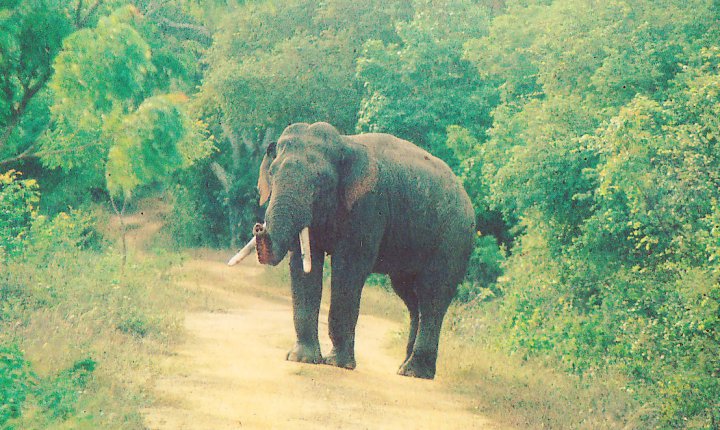
Reaching Percy Bendhi Wewa, we were astounded to come across a big elephant on the bund of the lake. Its head was in the bushes, but when it pulled out, we saw two gleaming shafts of ivory. It was a Tusker ! . He turned towards us, and raised its trunk feeling us out, and then slowly slid into the bushes and dissapeared from sight. I managed to get some photographs from my old film camera. And I treasured this moment ever since.


The years passed an I always wondered about this tusker whom I encountered so long ago, but did not get any positive update on him, until 2014, when a young boy from the village posted an image on facebook, hence I contacted him and he said he saw him in a chena deep in the village. I analyzed the photographs and compared with my old photos and realized this was truly the big tusker I had seen way back in 2003. It was 11 years from our first encounter, and it was heartening to know this tusker was still alive.

I made plans with him to head there one day and try and find him once again. We reached Wilpattu late at night as we left after office. Spending overnight at a village guest house we headed to the area hes known to be seen in the morning. Note even the village is a mix of forest, jungle, paddy cultivation and chena cultivation, hence its a scattered area with a mix of wilderness and human habitats. We looked everywhere by jeep and foot but couldnt locate any signs.

That evening we went to an abandoned chena cultivation , and waited until some village boys who were helping us went far into the bush looking for the tusker .We had stationed them in different areas to try and get a glimpse. Finally we go the call and we began to walk towards some harvested paddy fields. One of the village boys said hes on the way to this area and for us to remain out of sight as the tusker is very shy. It began to rain for a few minutes and we took shelter at a small coconut thatched hut which was abandoned. Waiting for over 30 -45 minutes we saw the head of the tusker as he came out into the open. He was the same beautiful bull I had see so long ago, and it was heartening to see him again. I noticed hes much older and abit worse for wear this time around plus I noticed his left eye didnt seem too good and we presume hes blind on that side.


He gently walked past us, and headed deeper into the bush. We were happy to see him alive after so long. Back home I decided to name him Wasantha in memory of the late park warden, and someone whose done so much for the park before his untimely demise.

Sadly few months later, we got news that a poacher was caught in Eluwankulam area with tusks similar to Wasantha's, and awhile later they found the location of the body. I was devastated to know of this , and heartbroken that such a peaceful animal met his demise at the hands of a greedy coward.

Unfortunately this is the sad fate of tuskers in this country. May his memory live on along with the legacy of the late Mr Wasantha Pushpananda.