Showing posts with label srilanka. Show all posts

Tuesday, May 25, 2021

Sri Lanka's top 5 places to see Leopards

Sri Lanka undoubtedly is the land of the leopard. This is one of the few places in the world where the leopard can claim the moniker of the apex predator of the wilderness. In other continents and countries such as India or Africa, the leopard needs to compete with larger and more formidable predators such as lions, tigers, and even Hyenas in the case of Africa.

In Sri Lanka, there is no such predator to compete with the leopard. The occasional scuffle with a wild boar and a sloth bear has been known to occur, but overall the leopards are free to hunt and feed unabated.

This level of freedom has further enabled some of the best daytime sightings of these magnificent predators on the island. Being the top predator in its habitat the leopards are more confident and can be seen out in the open, completely relaxed.

The Sri Lanka Leopard is a unique subspecies that is native to this island. They are also the largest subspecies along with the Iranian Leopard. For a trained eye, one can easily spot the difference between for example an African Leopard and a Sri Lankan Leopard. The facial structure and coloration are the key differentiators.

Hence for anyone who is keen on covering as many species and subspecies as possible, it is important to visit Sri Lanka and try and photograph and see the Sri Lankan Leopard.

That being the case, the question would arise which is the best place to see leopards in Sri Lanka?

This is a worthy question as Leopards are found in many parts of the island, but they are not seen as well in all places, especially in areas where they are not habituated.

This too is important as habituation to humans and vehicles is key in having great leopard sightings.

From decades of observation and hours spent in the field here are my top 5 places to see leopards in Sri Lanka


#1 – Yala National Park (Block 1)

Undoubtedly the top spot has to go to Yala National Park, the crown jewel of safari parks in the country. This is truly the land of the leopard, with some of the highest if not the highest densities of these amazing predators in the world. The sightings of a beautiful cat walking across the open plains or atop a rocky outcrop is a signature sight in Yala National Park. There are many famous leopards that have become household names in Yala. In the past big males such as the “Chaitya Male” (known to have been big and strong enough to bring down an adult buffalo) and Hamu was iconic. At present, a very detailed study on the leopards of the park are being carried out whereby over 130 individual leopards have been identified. Even now, new individuals keen getting identified, which showcases the vast density of these predators in such as small area which is only 142 Square Kilometers. Some of the notable characters during the present era to emerge from Yala are – Lucas, Julius, Harak Hora, and Aster to name a few. A very informative “Leopard Center” is present in the park where visitors can learn more about these predators and also compare one’s own sightings with the virtual database and try and identify the leopards they have spotted while on safari.


#2- Wilpattu National Park

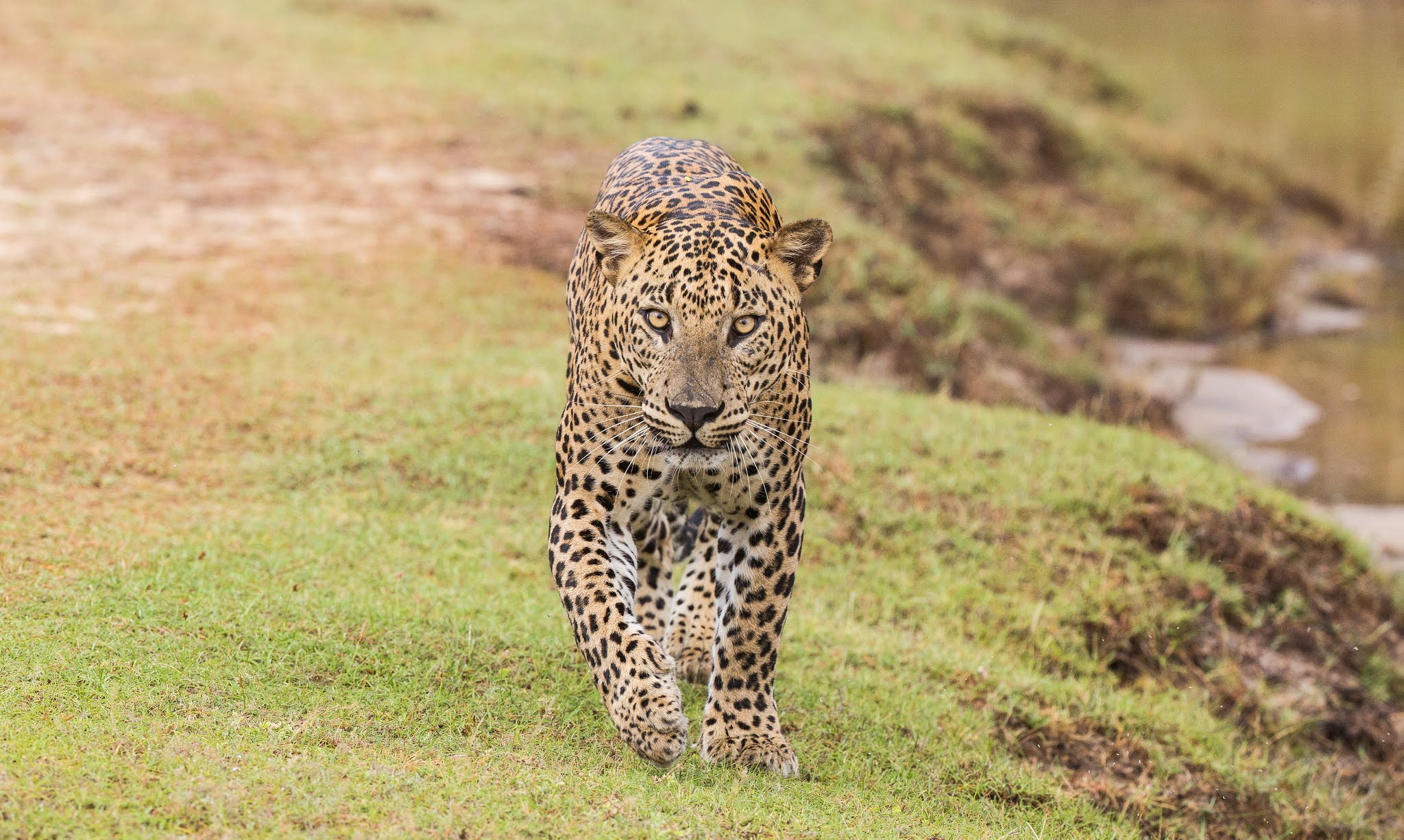
The land of lakes, Wilpattu is located on the North-Western end of the island. This is Sri Lanka’s largest national park and is quite a contrast to the landscape of Yala. Where Yala is mostly dry scrub forest, open lagoons, and plains, as well as many rocky outcrops, Wilpattu is denser with dark forests being the dominant landscape, along with few open spaces which are usually consisting of natural lakes known as Villus. The dense dark forests make it quite difficult to see these predators, but when they do come onto the roads it is a sight to behold. The open sand-brimmed lakes are some of the most beautiful settings to view these magnificent predators. The park was closed for many years during the time of the civil war and was finally opened to the public in 2010. During this time, the leopards were very shy and sightings were almost nonexistent. But over time, after a few years of continuous visitation, the leopards gradually became habituated enough to give some great sightings. Through the years, Wilpattu has become increasingly popular, especially with wildlife purists who seek more private and quieter moments compared to Yala which can tend to be congested and crowded. The chances of seeking leopards in Wilpattu is somewhat harder than Yala, but usually, the reward of the sighting is far greater most of the time due to the lower numbers in the park and the ability to spread out across the landscape given the size of the park. One of the most photographed leopards from back in the day was the infamous “Prince” a.k.a “Natta” who was a young male leopard who was born in the Kompanchi Sampuwal/Pomparippu area and later moved around to many parts of the park. He was at one time the most photographed leopard in Sri Lanka, giving shows like no other, often sleeping in the middle of the road paying no need to the on-looking people and vehicles. He was named Natta due to the fact that the end of his tail fell off due to an injury probably with a wild boar or another leopard. He is still alive but has been driven out to the fringes of the park by larger and more dominant males. One of the most famous and well-loved males of the park is the Nelum Wila Male, a massive individual who has a large home range and is seen quite often walking without fear of people. He is the current star of the park and one who literally poses for the photograph. When it comes to the female’s one of the most beloved leopards has to be “Cleopatra” the beautiful female who was known as a playful cub from Borupanwila. Now a successful mother with her own brood of cubs is seen by lucky visitors mostly in the Mahapatessa area with her cubs.


#3 Kumana National Park


Kumana, the land of mystery and awe is located on the far eastern corner of the island. In fact, it is connected to Yala and is part of the same ecosystem. But due to the access and location, it is quite a long drive to reach compared to Yala. Kumana was initially famous as a bird sanctuary with many species of birds nesting in the waters of Kumana Villu. But in the last decade or so, there has been an increasing number of leopard sightings in the park. The legends say the leopards of Kumana are known “man-eaters” and the leopards of Lenama (an area in the park) are mythically known to be larger and deadlier. But the reality is that these too are the same leopards that you see in Yala. But there have been cases of man-eaters in the park which are more than in many other parts of the island. In 2019 a construction worker was taken and eaten by a large male, who subsequently attacked and severely injured another individual who went to retrieve the body of the victim. Thereafter in 2020, another leopard attacked a farmer in the nearby area of Panama while sleeping in his watch hut. The man succumbed to his injuries. The same leopard thereafter attacked a few men on patrol at night in the fringes of their farms. The authorities managed to capture the culprit who was released deep inside the park which caused much controversy.

Despite these individual cases, the number of sightings of leopards is increasing as the animals become more habituated. The advantage of seeing leopards in Kumana is the privacy and lack of large crowds. Given the remoteness and difficulty to get to the park has resulted in making this one of Sri Lanka’s best-kept secrets.


#4 Veheragala (Yala Block 5)


Veheragala National Park also known as Yala Block 5 became popular in the last 6 years as an alternative to Yala Block 5. The small land extends borders the giant Veheragala reservoir and is less visited than its more famous counterpart. This park is also known for its fair number of leopards, often seen on the main road which runs through the park. The high density of prey animals such as Spotted Deer and Grey Langur may have resulted in the number of leopards seen, and gradual habituation has helped greatly in giving quality sightings. This is a great park to combine with when visiting Block 1 in order to get away from crowds and to get a change in landscape.


#5 Horton Plains National Park


The misty highlands of Sri Lanka is hardly a place one would imagine encountering a leopard but despite this, historically the highlands was where most of the islands forest cover was and where most of the wildlife animals roamed. With the onset of the British taking over the country, they cleared these vast forests, to grow Coffee and subsequently Tea.

One of the last remaining highland wilderness refuges is Horton Plains, National Park. Located over 2500 meters above sea level this montane wilderness is set atop a high plateau and is one of Mother Nature’s spectacular wonders.

Once even used by the government at the time to grow potatoes, it was later declared a National Park and a UNESCO World Heritage Site.

This land is one of the most sensitive and ecologically important locations in the country with a vast number of plant and animal life endemic and found nowhere else in the world.

The park was very popular for its scenic landscapes and walking trails. Subsequently was highly valued as a top birding destination to see some of the rare highland endemic species.

In the last few years, through countless visits and patience, this too has produced some unforgettable leopard encounters.

The kings of this domain, these predators are found in the deep dense cloud forests and on the fringes of the open plains which are the main landscapes of this habitat.

Feeding primarily on Sambhur the largest species of deer in Sri Lanka these cats seem to have a few physiological differences to their lowland cousins. The Horton Plains Leopards seem to be much larger in physical size and their faces wider with shorter muzzle areas giving them a stouter and wider look.

A study carried out by a a scientific team consisting of Dr Enoka Kudavidanage in 2020 has identified 23 adult leopards found in the park.

Seeing these majestic predators is much harder than in the lowlands but with a trained eye and patience you might have a chance in getting a glimpse of these highland beauties.  


Sunday, April 5, 2020

Leopard in Udawalawe

Around 7 years ago , I got news of a female leopard with some cubs being sighted in Udawalawe National Park. This park is more famous for its elephants, and seeing a leopard is an absolute rarity. The chance of seeing one would be a great opportunity, and hence myself and my friend Hamid decided to go on a day trip to the park early morning and try our luck.

We decided to drive into the park in Hamid's pickup rather than hiring a jeep. We set into the park early morning with some packed breakfast. We reached the rocky outcrop where the leopards were said to be sighted. It was a very tough place to spot anything as besides the rock, the surroundings were covered in 6-7 foot tall elephant grass. Hence we had to focus solely on the rock.

Waiting hours, we had no sighting whatsoever. We decided to head back out as the sun was getting quite hot, and have some lunch before returning back.

Back in the evening, we waited for a very long time circling the rock, and looking at all possible directions for a sighting. While doing the circle, suddenly one vehicle up front said the leopard just crossed the road from the side of the rock to the other side , into the tall grass.


We drove past where the alleged crossing had occurred and waited. Suddenly Hamid spotted the leopard peering from the edge of the grass from his rear view mirror. As we had no time to turn around I opened the door slightly and put my lens out. I caught a glimpse of the leopard hiding in the grass. The angle which I was turning aroound and holding the heavy lens gave me a massive cramp on my torse, but I gritted my teeth and waited , expecting it to cross the road.


But before I could even click my camera the young leopard dashed across like Grease Lighting !

Back in the car, I was wincing in pain from the cramp, and checked my camera thereafter. I had managed to catch only one shot of the cat peering through the bush, the crossing was too fast. But I was not upset as I was very happy in seeing a leopard finally in Udawalawe which is one of the rarest sightings one could get.


Saturday, April 4, 2020

Memories- My first visit to Yala National Park


Yala or Ruhunu National Park is the most famous Safari destination in Sri Lanka. The park was out of bounds for a few years due to a terrorist attack in 1996, therefore even after Yala was re opened to the public the school did not want take any risks by taking young school chindren into a place with another possible terrorist threat. I had heard so many stories about Yala, and had seen many old black and white photographs of my mothers trip to the park. Finally during the April holidays of 2000, I was able to go to park which I have heard so much about. For me, this was a big step up from what I was used to. The parks I used to visit at the time, Wasgamuwa, Udawalawe and Bundala all had elephants, but we hardly saw other animals. Even the deer were very shy in these other parks, thus it was a big surprise for me to see so many spotted deer in such close proximity, and being so used to vehicles. It was also the first time I saw wild boar.


We camped at Jamburagala Camp Site, which had a small cement structure, thus not requiring tents. Water was supplied by a well some distance away for water. We were strictly instructed not to go to the well alone as the place was next to some rocky outcrops which were frequented by bears. I remember the well being very stale and the water was very brackish with small shrimp like crustaceans floating on the surface. That evening at around 10.00 PM we heard the unmistakable rumble of an elephant very close to the camp site. Mr. Rohan one of our school masters who joined us on the trip was sleeping in the jeep closest to the elephant. Nirmal Sir had warned us of the phobia Mr Rohan had of elephants. I slowly woke him and whispered that there is an elephant close by. He yelped in fright and scrambled from the back seat into the front seat of the jeep, and from there made a hasty retreat towards the building. The elephant clearly frightened by the noise went on it way. We were in fits of laughter, as Mr. Rohan on other occasions was a very tough individual.


The next day morning we were driving along Uraniya road, and while taking a bend came face to face with a tusker. This was my first tusker in the wild and I was extremely excited. This tusker was named Anuradha and I couldn’t believe my luck, a tusker on my first park round in Yala. We had a face off for a few minutes, and then the tusker went on its way into the bush. Still buzzing with excitement from the encounter I had a hearty breakfast and worked on the camp chores till evening. In the evening round while heading back to the campsite from an uneventful safari I encountered my first leopard on the middle of the road in Jaburagala. It was a large male, and after snarling at the lights of the jeep (it was pitch dark), it started walking along the road, and we followed it, for some distance before it slunk into the darkness of the forest. I was beyond words by then a tusker and leopard in one day was something I could never have imagined back then.  


That night we were all in a jubilant mood, and Nirmal sir seemed to be a little at ease as well , and allowed us to bathe at the well for a little longer than normally allowed. I was given a small camp bed by my friend Bimantha, and I remember it being so flimsy that it would collapse down if I moved too much, and I slept very carefully because Rohan Uncle was sleeping on the floor next to me and as he was very irritable I did not want to upset him. I slept soundly and in the morning I tried to slowly get off the bed and  quietly step over the sleeping Rohan Uncle, but suddenly the bed gave way and  it collapsed with Rohan Uncle underneath. I believe he would have had the shock of his life and the bed with all my weight fell on top of him. I swiftly jumped off him and darted out to the open before he could catch me. I heard him loudly cursing back at the scene of the incident, and I hid from him for the rest of the day.


The next few days we saw one more tusker on the main road. Its name was Kublai Khan after the great Mongol Emperor. It gave a small mock charge and thereafter remained on the road for more than 30 minutes, so we turned back and headed the other direction. We also took part in a small project where we put up sign boards along the Palatupana road warning vehicles of crossing animals and urging them to slow down. This was due to a request made by the park warden as many animals, especially small ones such as monitor lizards and black naped hare, were being run down. We were also given a lecture about the park by one of the senior rangers who visited our campsite. Back then I maintained a field book with notes on all my sightings, and learning’s from each trip.


My first visit to Yala will never be forgotten and will be the first of many visits to this amazing park.

Memories-My First Camping Trip in the Wilds


I will never forget the first meeting of the Wildlife Society which I attended in 1997.  I was the youngest member, and all the other boys were seniors in their late teens. This did not hold me back and I signed up for the first trip of the year, which was a 5 day camping excursion to Udawalawe. The cost was very minimal back then, and the charge per head was around 400 Rupees.  The master in charge Mr. Nirmal Fernando also known as “A.E.N Sir” due to his initials was a very tough character and I was mortally afraid of him as he was our caning master in school, and I had received quite a few lashings in my first term at College. Nirmal Sir in the future years became a very close mentor of mine, and even to this day is like a father to me.


The plan for the trip was that we assemble in front of the College gate at 4.00 AM in the morning. My mother had to dive me there, and brought along Nishantha one of my neighbors as a chaperone as she would have to drive back alone in the dark, as my father was overseas on work. I remember it was a very organized affair, and there were around four jeeps in total, all provided by one of the parents of the boys named Rohan Kulatunga, who we called Rohan Uncle, who would play a big role in most of my jungle adventures in the coming years. We departed at around 5.00 AM, and I was put in a jeep along with all the other junior members, Daham, Bimantha and my cousin Dilsiri. I was the only fresher as the others had gone on trips before me, and I had a mixed feeling of excitement and nervousness. This is the first time I was off on my own without my parents and my mother ensured that I had everything I needed, from food, to a complete list of clothes and toiletries. I remember my mother was worried about mosquitoes and ensured that I take a dose of quinine as well as a full stock of repellent. She had packed her famous home made pizzas for my breakfast, and as soon as the seniors got a whiff of it, it disappeared before I could even have a bite. The ride seemed long and tiring, reason being that the roads weren’t as good as they are now, and also because these jeeps were old land rovers and land cruisers and were not made for comfort, but I did not mind, the adventure was something I was looking forward to for a very long time. We reached the park entrance by noon, and headed towards our campsite, Alimankada (Elephant Pass). I was tremendously excited about the fact that we were camping next to a river.  But I did not have time to be idling as there was lots of work to do, as 30 of us got together to set up the campsite and prepare lunch. After a good meal we had a nice cool dip in the river, but Nirmal Sir did not let me go too far as he was responsible for my safety and thus kept me close to the riverbank. The evening game drive was not that eventful and I cannot recall any sightings of elephants. 


Back at the campsite, I had a major dilemma. I need to answer the call of nature, but as I had never been in the outdoors, I was very uncomfortable of going the bush to relieve myself. I asked the cook Ranji to accompany me, and I still remember me being very embarrassed that I had to go out in the open where everyone can see me.  In the night we all gathered around the campfire, and Nirmal Sir, Rohan Uncle and the seniors shared with us their experiences and knowledge about the wild. I was allocated to a tent where all the juniors slept. It was very uncomfortable I remember, because it was raining and the tent was leaking from certain areas, and the heat was pretty unbearable.

In the morning we had a nasty surprise, someone had left some fried “papadam” underneath a jeep at night, and entire army of “kadiya’s” had invaded the campsite. There were literally millions of these soldier ants whose bite was very painful and they were all over the campsite and despite the efforts of using Kerosene oil, we were left with no choice but to move camp. 

The new campsite was called Pansadara, which was a much larger and we had more room to spread out our tents.  During the evening I witnessed my first herd of wild elephants.  I also recall an encounter with two big bulls that had a brief face off before engaging in a short duel. I noticed that many of the boys had cameras with them, and I was longing for one of my own, to capture all these memories. This yearning is what made me try my hand at photography many years later.


 The following days got me accustomed to the rhythm of the jungle life, I learnt many camp chores such as how to pitch a tent, how to clean vegetables for the kitchen, and how to light and clean a hurricane lantern. These and many more skills have helped me take on any problem and hardship in life. I will always remember this first venture into the jungles of Sri Lanka, as it not only gave me the first taste of the wilderness, but it made me who I am today.


Friday, April 3, 2020

My Experience with Leopards of Horton Plains


Horton Plains is a place which is close to my heart and arguably would be my favorite place in the world. The land of mist and rain, of rolling green hills and dark cold forests. This is one place which always held a mystery with it, and an emotion hard to describe. I have been travelling to this park since I was very young, and in-fact my family have taken me even as a 3 month old infant on the regular trails of this beautiful park. But very few have truly attempted to catch a glimpse of its unique wildlife up close and spend time focusing on finding the rare, elusive and endemic until recently. Few people are aware that the park has a thriving leopard population, as very few are lucky enough to catch a glimpse of these elusive predators.

Hence determined to see one, myself and my friend Hamid made our way one March to spend 3 days in the park in the hopes of photographing a leopard. We had booked the Maha Eliya Bungalow which is located right in the heart of the plains and a good launching pad for our search.On the first night itself we had our first encounter, as Hamid went out to where he has parked his pick-up truck to charge his phone and suddenly noticed a large male leopard seated in front of the car watching him. When he turned his flashlight the leopard had disappeared into the darkness. Skeptical of this I went ahead on the path in front of the bungalow to check for tracks and noticed the pugmarks confirming the incident. The next day we were up early and set off on our drives along the park main road from the bungalow all the way to the Pattipola Entrance gate, and then back towards the Park Office and to the Ohiya Entrance Gate. This is known as the best stretch of road where leopards have been seen. The mornings were bitterly cold and very misty hence we found it tough to get a good view, but we heard a few alarm calls of Sambhur who are the leopards main prey but didn’t get any sightings.

That evening, we were driving around, and the weather was great with no mist and good light. We were driving towards the Park Office, and were observing how good the light was on the left side of our vehicle where there was a wide open valley, when something caught Hamid’s eye on the right. It was a leopard sitting by the roadside just watching us pass by. He hit the brakes pretty hard and I went flying forward as I was not wearing a belt at the time. In Hamid’s excitement he accidently pressed the horn while trying to take out his camera, and the shy cat walked into the bush. But it wasn’t particularly alarmed as it walked away calmly. We waited at that spot, scanning the area for a very long time, but to no avail, and hence turned back and was heading towards our bungalow when we heard some Sambhur alarm calls ahead, and when we drove to the spot we observed the directions the herd of Sambhur were looking at and out came this gigantic male leopard. It was easily the biggest leopard I had ever encountered, and the color was a beautiful golden yellow. The leopard was quite a distance away on an opposite hillock and was walking away from us. I managed to capture two blurry images of the cat as it moved out of sight. We were in disbelief, our first sightings of leopards in Horton Plains, and how magnificent they were.


The next day was uneventful, but on our last morning drive, while driving towards Arrenga Pool from the Maha Eliya side, there comes an opening where there is a valley on the right which extends all the way to the Thotupola Kanda forest tree line, and immediately as we reached there, Hamid with is amazing eye sight spotted a big leopard peeping from the forest edge, but took some time to maneuver his pick-up truck to the side of the road by which time the leopard once again slid back into the dark forest. We were kicking ourselves and thinking what an amazing shot it would have been, when the leopard once again came out, and this time I had made a fatal error in sitting on the passenger side on the left, hence I had to get down from the vehicle to get a clear shot. By the time I did that, I missed the shot again. Thankfully Hamid had taken a brilliant photograph of the large male leopard. I immediately went to the back seat where I can get a view of the right side window and waited. We knew the cat is in the bush and will most likely come out once again. We waited for over half an hour, and suddenly heard a belting of a Sambhur as a young deer leapt out of the bush followed by the leap of the leopard as it reached out to grab its prey. But missing its reach, it jumped back into the bush further away. This was some amazing action we were witnessing. Another several minutes later, we suddenly noticed the leopard has appeared in the open plains, hidden in the tall grass. We could barely make out the head as the sun was very bright and at that angle was proving quite difficult to photograph. After several minutes the shadowy shape disappeared from our sight once again. Despite not having any photographs of the sighting, I was exhilarated and in awe of what we had just witnessed. Especially because we have come to this park so many times throughout the years and had never ever thought we would witness something like this. I think in hindsight it is because we don’t look out for such things and the leopards in general are always around and if one with keen eyes does make the effort it would appear. It is up to the observer to make it so.

Notice the head of the leopard hiding in the grass

Following this trip, I made several visits subsequently, but with no luck, mainly due to the thick fog which makes sightings impossible. This was until a trip we made in 2018 when we stayed at the Wildlife Department Dormitory, a very basic establishment but also a good place to locate oneself strategically to try for leopard. The days went by, without any luck. But we did get a great sighting of an Eurasian Otter swimming quite freely in the Arrenga Pool. Our group consisted of my friend Hamid and his son Nasir, as well as my best friend Chathuranga fondly known as “Chatta”. On our last evening we drove towards the Maha Eliya plains, and noticed a car with some photographers were already waiting in anticipation of a sighting. This was the same area where we saw the big male leopard walking in my first encounter few years before. We decided to drive up ahead and turn the car around and come back, and when we did we were all focusing elsewhere when Chatta suddenly said “what is that” and pointed towards the grass. We saw then that it was a leopard peeping from the grass and looking straight at some Sambhur who hadn’t noticed it yet. Without a seconds thought, we began clicking our cameras as we knew the moment would last only a few seconds. As predicted the shy cat turned back and went into the deep forest. We were very lucky thanks to my friend Chatta in spotting this, as other car despite being in a similar viewing position didn’t notice it.


 Subsequent trips to this amazing place hasn’t proven lucky with regards to leopard sightings, but it is always an unbelievable experience to travel to Horton Plains and to spend time in this amazing mountain wilderness.


Sunday, February 25, 2018

Meeting Gajaba the legendary Tusker


My story with Gajaba the mighty tusker found in the North Central region of the country , starts over 5 years ago, with a random video clip seen on facebook of this gigantic specimen of an elephant patrolling a lake bed along with a herd of elephants. The bull was significantly taller than all the elephants around, and I was amazed at the sheer size and majesty of this elephant.

 I spend many months trying to get more details about him, and befriended a local in the area who would end up becoming a very close friend and ally in conservation of elephants in this area.

 Sadly elephants in the area are found outside national parks, and in and among human habitats. They are in eternal conflicts with people and there are major casualties on both sides. People as well are struggling to eke out a living farming and the elephants who have nowhere else to go, are tempted by the nutritious crops which are grown by the villagers and will raid them at night. A single harvest of a poor villagers will be eaten in one night, hence it is not a surprise that people retaliate. At its most basic, the elephants are chased away by large fire crackers issued by the Department of Wildlife, but some people take it to the next level and using rudimentary shotguns will attempt to harm the elephants, which at most cases end up with grievous injuries, which maim but do not kill. This makes the situation worse and these enraged elephants will be even more aggressive and dangerous. In much worse cases the young would fall victim to homemade explosives such as Hakka Pattas which are originally intended for wild boar but unsuspecting young elephants are easy prey and many a young animal are found either killed or with shattered jaws. Another means of harm for elephants are the large unprotected agricultural wells. Both adult and young elephants fall into these dangerous pits which are without any walls and in worse cases the elephant either drown or are permanently injured beyond recovery. Another sad state which I have observed I these areas are when the herds come out to drink at local lakes and tanks, which are generally bordering forest, how some youth whom tent in the lake area having alcohol, going over and chasing the elephants and panicking the herds just for the kicks. this is harmful I that not only do the poor animals have no means of drinking water peacefully but the panicked animals will run amok on another village., hence no good would come of this, but it is happening on a daily basis and something I have seen in my own eyes.


The tusker whom I am writing about, was hence found in an area of such turmoil, hence from the onset I know my search is not going to be easy. My search began in 2013, and after news of him coming out to the open in the dry season, I started travelling to this region on a regular basis. Usually we hired a jeep from a nearby national park, and traverse the many village roads, lakes and abandoned chena cultivation's, asking for information where the elephants were last seen, and if any noises can be heard from the forest such as breaking branches which are a clear sign of the pachyderms being nearby. But even if there were elephants nearby there is no guarantee that the tusker in question will be there. There are hundreds of elephants in this region, and to pinpoint this particular tusker is like finding a needle in a haystack. Despite all the obstacles ahead of me, I never gave up. I traveled so often in search of him that I have lost count. I do remember many an occasion where I have risked my own life to try and find this amazing bull. I can remember the time when we walked into a reed bed in search of him, and were hidden among the reeds where the herd of elephants surrounded us. We remained silent and calm until they went into the forest, but I realized this was too close for comfort and a risk I shouldn’t have taken.

 My first sighting in 2013
 Gajaba Running into the forest after seeing us in 2013
 My first sighting in 2013

But the yearning to see and photograph this magnificent bull kept me going. On one fateful day, we got news that he has been sighted on a lakebed and hence I took leave and immediately made our way to the area alone with a few other elephant enthusiasts. We waited for quite some time and at around 5 PM the herd started gradually coming out into the open. The elephants kept pouring out, from young calves to adolescent bulls trying to get the attention to the females as well as mature bull elephants. There were over 100 elephants in this herd, and around5-6 tuskers, of various sizes. This is a very rare occasion as only a few of the males in Sri Lanka have ivory. But my patience was wearing thin, and it was getting dark and we were about to walk back when we were told from some others nearby that the tusker is slowly coming out into the open. We waiting and out he came, but it was so dark my camera back them was unable to capture anything significant. But the bull was magnificent, which amazing muscular body and log tusks. He walked parallel to us, and as soon as he came in front of us, he stopped, turned towards us, gave a good look and ran back in. He is very shy by nature and this is the reason he has survived so log without getting killed. I was nevertheless in awe, and amazed at finally seeing him, but of course wasn't 100 percent happy as the images I wanted didn't materialize. I was determined to see him again, and hence continued on my quest for many years to come. But so many times I either missed him by a few minutes or was a little too early and hence this mythical tusker kept evading me for all these years.


Finally in 2016, I went once more, with a blind hope that I had since 2013, with the sense that I will see this magnificent bull tusker, perhaps the last of his kind in terms of genetics producing such a large physique.

We went into a massive lake bed, hoping he would show up there. There were few elephants out in the open, but the big bull was nowhere to be seen, then we got a call from one of my trusty trackers that he’s in a lake closely. hence using our hired jeep we traversed via bumpy roads and made our own path sometimes over abandoned paddy fields etc to finally make it to the lake. And there he was in the edge partially hidden it he forest. He was with a few younger elephants. and after we came there, he went inside the forest. We waited patiently and after a few minutes the bull slowly stepped out. His full size and majesty was out for everyone to see. The local villagers having baths in the lake were equally amazed by the tuskers size and majestic appearance as he was strutting around clearly in full musth. He was showing particular interest in a female, but she was so small, and was almost half his size. If she is in heat he will continue to follow her till he gets the chance to mate with her. This was finally the moment where all my years of travelling and suffering with thousands upon thousands of rupees spent are rewarded with this amazing sighting which I will never forget for the rest of my life.


After many hours spend admiring this spectacle, we decided to head back home, full of memories and the small hope that this bull will continue to paws on his genera and remained free to roam the lands of Lanka till his drying day.
Few years later, once again, we got news of his appearance in a village tank, and I had just finished guiding a client in Wilpattu, and decided to head over the area where hes been seen with my trusty safari driver.

Reaching the area, I met up with my local friend and headed to the lake where hes said to have been seen. When I arrived there were a few photographers from Colombo already there and waiting for him. I crouched down and crawled upto a small embankment, and on the other side of this was a small herd of elephants, and our friend Gajaba among them. He was feeding peacefully and strolling among the herd while in musth seeking out any receptive females.

We spent the entire evening with him and the herd, and it was simply magical. I noticed how comfortable hes got over the years since I first saw him to the presence of people, as he was completely at ease with our presence.


It was also heartwarming to see a very young tusker, almost 1/10th his size playing by his feet. The future generation of giant tuskers from this region is secure if we choose to protect it. Sadly this was a village lake and as such this whole region truly has no complete protected space for these majestic giants. Hence it is an eternal struggle for over 200 elephants in this region to survive in this shrinking habitat.


 Unless drastic measures are taken to establish protected areas and proper demarcations of land , it is most likely tuskers like Gajaba and all the other elephants outside national parks will meet a quick and agonizing demise. 


Sunday, May 17, 2015

Rarity is snow white

There are few things which can be considered truly mind bogglingly hard to find. The rarity make the aura of its/their existence almost mythical. Given this context, the knowlege of a very rare recessive gene in a particular troop of endemic species of monkeys found only in Sri Lanka is music to my ears.  the particular recessive gene in mention creates a white morph in select troops of these primates. This white morph is different to the albino in that the animal affected does not suffer the extreme de pigmintation suffered by the albino's with red eyes and pale skin. But rather certain parts of the body are affected like the fur and certain areas of the skin. Further the eyes tend to remain unaffected much like the blue eyes found in certain white tigers and lions. This feature makes the animal in mention extremely beautiful and  a feast for the eyes.


I heard about this elusive troop of monkeys who contained a few of these rare individuals, hidden in the deep dark corners of the countries wet zone. Despite a few attempts of finding them, I was not that lucky.

This time around of course I was not really trying to find the monkeys but was rather doing a sort of reconnasance for my next trip when I spotted a snow white individual crossing my path. Getting all excited I scrambled to a suitable vantage point to view this rare beauty. To my amazement the individuial I saw was a fully mature adult female who had a sort of "pied" apperaance where few areas still had traces of black. What was amazing was that the female was carrying a white baby. This was amazing to see as this adult is clearly breeding and producing white offspring. There was yet another juvenile among the trees whose white was even more pronounced. More forward than the big female this youngster got into view and remained feeding on a tree. What an amazing sight this was, it was one of the few moments in my life which I can say was not only breathtaking but life altering. Seeing such a rare animal in my own eyes was such a pleasure.


This is a white morph of the endemic purple faced leaf monkey, who is black/purple in color with the whiskers being white or grey. There are 5 subspecies of this monkey with key differences in coating in all of them.


Well known environmentalist Rohan Pethiyagoda, says this is due to a phenomena known as leucism. Leucism is a condition characterized by reduced pigmentation in animals that gives colour to their skin and fur. In the case of albinism, it is the reduction of a skin pigment melanin, but in this case a reduction in all types of skin pigments occur. “Clearly the leucistic gene has been spreading across several troops and may even be selected, if males prefer white females.


White may prove to be disadvantagoes for aniamls as they are easier to spot by predators. But maybe in this case there are few predators around and with a big troop such as this the survival rate might be higher. The rest of the troop seen by myself were having the normal color of this species.