This blog contains my personal memoirs of my travels, experiences and adventures into the wilds of Sri Lanka. I hope that through this blog I can impart my love for this wonderful country and its natural beauty to the reader and encourage them to conserve and preserve this heritage for future generations.
Around 7 years ago , I got news of a female leopard with some cubs being sighted in Udawalawe National Park. This park is more famous for its elephants, and seeing a leopard is an absolute rarity. The chance of seeing one would be a great opportunity, and hence myself and my friend Hamid decided to go on a day trip to the park early morning and try our luck.
We decided to drive into the park in Hamid's pickup rather than hiring a jeep. We set into the park early morning with some packed breakfast. We reached the rocky outcrop where the leopards were said to be sighted. It was a very tough place to spot anything as besides the rock, the surroundings were covered in 6-7 foot tall elephant grass. Hence we had to focus solely on the rock.
Waiting hours, we had no sighting whatsoever. We decided to head back out as the sun was getting quite hot, and have some lunch before returning back.
Back in the evening, we waited for a very long time circling the rock, and looking at all possible directions for a sighting. While doing the circle, suddenly one vehicle up front said the leopard just crossed the road from the side of the rock to the other side , into the tall grass.
We drove past where the alleged crossing had occurred and waited. Suddenly Hamid spotted the leopard peering from the edge of the grass from his rear view mirror. As we had no time to turn around I opened the door slightly and put my lens out. I caught a glimpse of the leopard hiding in the grass. The angle which I was turning aroound and holding the heavy lens gave me a massive cramp on my torse, but I gritted my teeth and waited , expecting it to cross the road.
But before I could even click my camera the young leopard dashed across like Grease Lighting !
Back in the car, I was wincing in pain from the cramp, and checked my camera thereafter. I had managed to catch only one shot of the cat peering through the bush, the crossing was too fast. But I was not upset as I was very happy in seeing a leopard finally in Udawalawe which is one of the rarest sightings one could get.
My story with Gajaba the mighty tusker found in
the North Central region of the country , starts over 5 years ago, with a
random video clip seen on facebook of this gigantic specimen of an elephant
patrolling a lake bed along with a herd of elephants. The bull was
significantly taller than all the elephants around, and I was amazed at the
sheer size and majesty of this elephant.
I spend many months trying to get more details
about him, and befriended a local in the area who would end up
becoming a very close friend and ally in conservation of elephants in this
area.
Sadly elephants in the area are found outside
national parks, and in and among human habitats. They are in eternal conflicts
with people and there are major casualties on both sides. People as well are
struggling to eke out a living farming and the elephants who have nowhere else
to go, are tempted by the nutritious crops which are grown by the villagers and
will raid them at night. A single harvest of a poor villagers will be eaten in
one night, hence it is not a surprise that people retaliate. At its most basic,
the elephants are chased away by large fire crackers issued by the
Department of Wildlife, but some people take it to the next level and using
rudimentary shotguns will attempt to harm the elephants, which at most cases
end up with grievous injuries, which maim but do not kill. This makes the
situation worse and these enraged elephants will be even more aggressive and
dangerous. In much worse cases the young would fall victim to homemade
explosives such as Hakka Pattas which are originally intended for wild boar but
unsuspecting young elephants are easy prey and many a young animal are found
either killed or with shattered jaws. Another means of harm for elephants are the
large unprotected agricultural wells. Both adult and young elephants fall into
these dangerous pits which are without any walls and in worse cases the
elephant either drown or are permanently injured beyond recovery. Another sad
state which I have observed I these areas are when the herds come out to drink
at local lakes and tanks, which are generally bordering forest, how some youth
whom tent in the lake area having alcohol, going over and chasing the elephants
and panicking the herds just for the kicks. this is harmful I that not only do
the poor animals have no means of drinking water peacefully but the panicked
animals will run amok on another village., hence no good would come of this,
but it is happening on a daily basis and something I have seen in my own eyes.
The tusker whom I am writing about, was hence
found in an area of such turmoil, hence from the onset I know my search is not
going to be easy. My search began in 2013, and after news of him coming out to
the open in the dry season, I started travelling to this region on a regular
basis. Usually we hired a jeep from a nearby national park, and traverse the
many village roads, lakes and abandoned chena cultivation's, asking for
information where the elephants were last seen, and if any noises can be heard
from the forest such as breaking branches which are a clear sign of the
pachyderms being nearby. But even if there were elephants nearby there is no
guarantee that the tusker in question will be there. There are hundreds of
elephants in this region, and to pinpoint this particular tusker is like
finding a needle in a haystack. Despite all the obstacles ahead of me, I never
gave up. I traveled so often in search of him that I have lost count. I do
remember many an occasion where I have risked my own life to try and find this
amazing bull. I can remember the time when we walked into a reed bed in search
of him, and were hidden among the reeds where the herd of elephants surrounded
us. We remained silent and calm until they went into the forest, but I realized
this was too close for comfort and a risk I shouldn’t have taken.
My first sighting in 2013
Gajaba Running into the forest after seeing us in 2013
My first sighting in 2013
But the yearning to see and photograph this
magnificent bull kept me going. On one fateful day, we got news that he has
been sighted on a lakebed and hence I took leave and immediately made our way
to the area alone with a few other elephant enthusiasts. We waited for quite some
time and at around 5 PM the herd started gradually coming out into the open.
The elephants kept pouring out, from young calves to adolescent bulls trying to
get the attention to the females as well as mature bull elephants. There were
over 100 elephants in this herd, and around5-6 tuskers, of various sizes. This
is a very rare occasion as only a few of the males in Sri Lanka have ivory. But
my patience was wearing thin, and it was getting dark and we were about to walk
back when we were told from some others nearby that the tusker is slowly coming
out into the open. We waiting and out he came, but it was so dark my camera
back them was unable to capture anything significant. But the bull was
magnificent, which amazing muscular body and log tusks. He walked parallel to
us, and as soon as he came in front of us, he stopped, turned towards us, gave
a good look and ran back in. He is very shy by nature and this is the reason he
has survived so log without getting killed. I was nevertheless in awe, and
amazed at finally seeing him, but of course wasn't 100 percent happy as the
images I wanted didn't materialize. I was determined to see him again, and
hence continued on my quest for many years to come. But so many times I either
missed him by a few minutes or was a little too early and hence this mythical
tusker kept evading me for all these years.
Finally in 2016, I went once more, with a blind
hope that I had since 2013, with the sense that I will see this magnificent
bull tusker, perhaps the last of his kind in terms of genetics producing such a
large physique.
We went into a massive lake bed, hoping he would
show up there. There were few elephants out in the open, but the big bull was nowhere
to be seen, then we got a call from one of my trusty trackers that he’s
in a lake closely. hence using our hired jeep we traversed via bumpy roads and
made our own path sometimes over abandoned paddy fields etc to finally make it to
the lake. And there he was in the edge partially hidden it he forest. He was
with a few younger elephants. and after we came there, he went inside the forest.
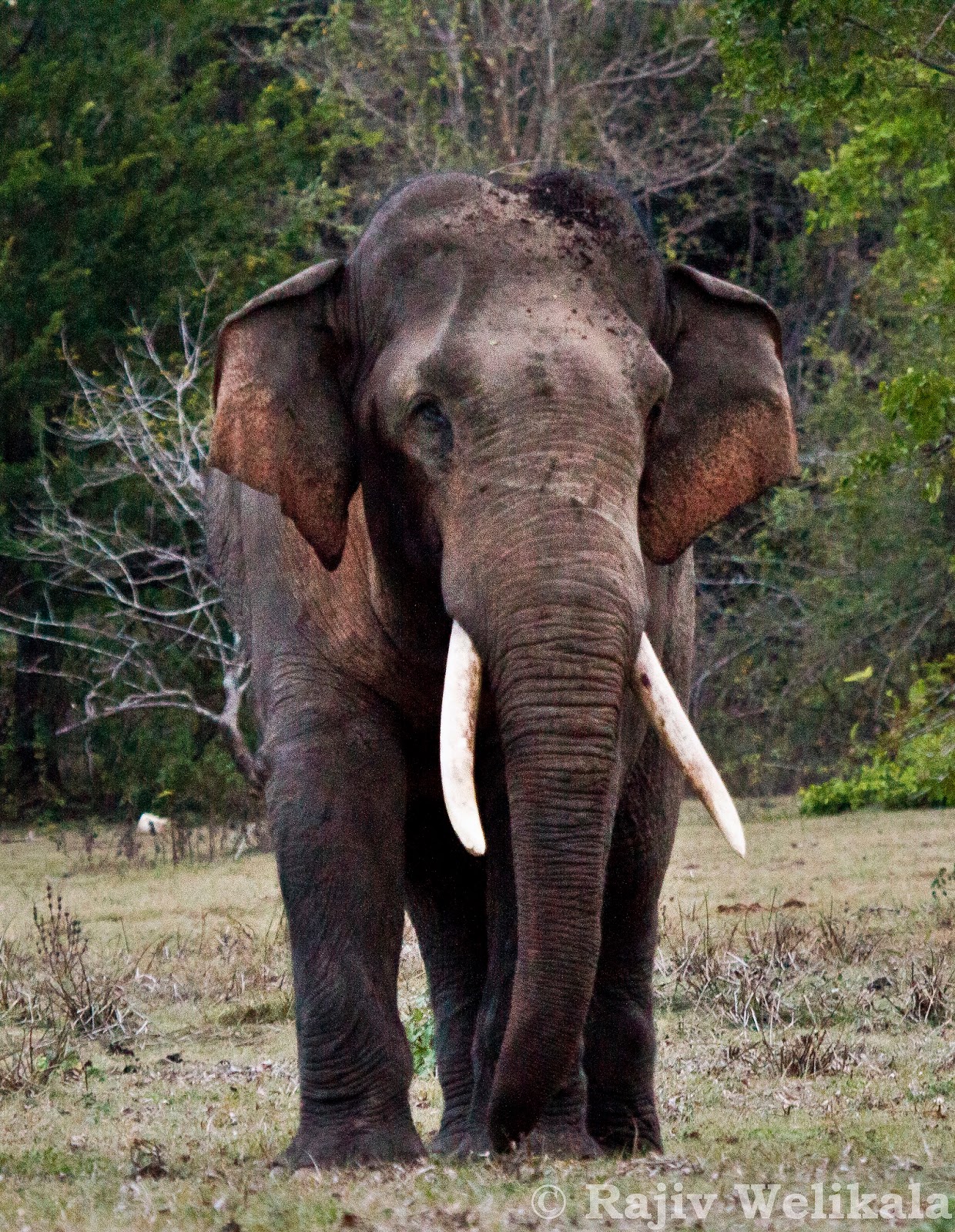
We waited patiently and after a few minutes the bull slowly stepped out. His full
size and majesty was out for everyone to see. The local villagers having baths
in the lake were equally amazed by the tuskers size and majestic appearance as
he was strutting around clearly in full musth. He was showing particular
interest in a female, but she was so small, and was almost half his size. If
she is in heat he will continue to follow her till he gets the chance to mate
with her. This was finally the moment where all my years of travelling and
suffering with thousands upon thousands of rupees spent are rewarded with this
amazing sighting which I will never forget for the rest of my life.
After many hours spend admiring this spectacle,
we decided to head back home, full of memories and the small hope that this
bull will continue to paws on his genera and remained free to roam the lands of
Lanka till his drying day. Few years later, once again, we got
news of his appearance in a village tank, and I had just finished guiding a
client in Wilpattu, and decided to head over the area where hes been seen with
my trusty safari driver. Reaching the area, I met up with my local friend and headed to the lake where hes said to have been seen. When I
arrived there were a few photographers from Colombo already there and waiting
for him. I crouched down and crawled upto a small embankment, and on the other
side of this was a small herd of elephants, and our friend Gajaba among them.
He was feeding peacefully and strolling among the herd while in musth seeking
out any receptive females. We spent the entire evening with him
and the herd, and it was simply magical. I noticed how comfortable hes got over
the years since I first saw him to the presence of people, as he was completely
at ease with our presence.
It was also heartwarming to see a
very young tusker, almost 1/10th his size playing by his feet. The
future generation of giant tuskers from this region is secure if we choose to
protect it. Sadly this was a village lake and as such this whole region truly
has no complete protected space for these majestic giants. Hence it is an
eternal struggle for over 200 elephants in this region to survive in this
shrinking habitat.
Unless drastic measures are
taken to establish protected areas and proper demarcations of land , it is most
likely tuskers like Gajaba and all the other elephants outside national parks
will meet a quick and agonizing demise.