Sri Lanka undoubtedly is the land of the leopard. This is one of the few places in the world where the leopard can claim the moniker of the apex predator of the wilderness. In other continents and countries such as India or Africa, the leopard needs to compete with larger and more formidable predators such as lions, tigers, and even Hyenas in the case of Africa.
In Sri Lanka, there is no such predator to compete with the leopard.
The occasional scuffle with a wild boar and a sloth bear has been known to
occur, but overall the leopards are free to hunt and feed unabated.
This level of freedom has further
enabled some of the best daytime sightings of these magnificent predators on
the island. Being the top predator in its habitat the leopards are more
confident and can be seen out in the open, completely relaxed.
The Sri Lanka Leopard is a unique
subspecies that is native to this island. They are also the largest subspecies
along with the Iranian Leopard. For a trained eye, one can easily spot the difference
between for example an African Leopard and a Sri Lankan Leopard. The facial
structure and coloration are the key differentiators.
Hence for anyone who is keen on
covering as many species and subspecies as possible, it is important to visit
Sri Lanka and try and photograph and see the Sri Lankan Leopard.
That being the case, the question
would arise which is the best place to see leopards in Sri Lanka?
This is a worthy question as
Leopards are found in many parts of the island, but they are not seen as well
in all places, especially in areas where they are not habituated.
This too is important as habituation
to humans and vehicles is key in having great leopard sightings.
From decades of observation and
hours spent in the field here are my top 5 places to see leopards in Sri Lanka
#1 – Yala National Park (Block 1)
Undoubtedly the top spot has to
go to Yala National Park, the crown jewel of safari parks in the country. This
is truly the land of the leopard, with some of the highest if not the highest
densities of these amazing predators in the world. The sightings of a beautiful
cat walking across the open plains or atop a rocky outcrop is a signature sight
in Yala National Park. There are many famous leopards that have become
household names in Yala. In the past big males such as the “Chaitya Male”
(known to have been big and strong enough to bring down an adult buffalo) and
Hamu was iconic. At present, a very detailed study on the leopards of the park
are being carried out whereby over 130 individual leopards have been
identified. Even now, new individuals keen getting identified, which showcases
the vast density of these predators in such as small area which is only 142
Square Kilometers. Some of the notable characters during the present era to
emerge from Yala are – Lucas, Julius, Harak Hora, and Aster to name a few. A
very informative “Leopard Center” is present in the park where visitors can
learn more about these predators and also compare one’s own sightings with the
virtual database and try and identify the leopards they have spotted while on
safari.
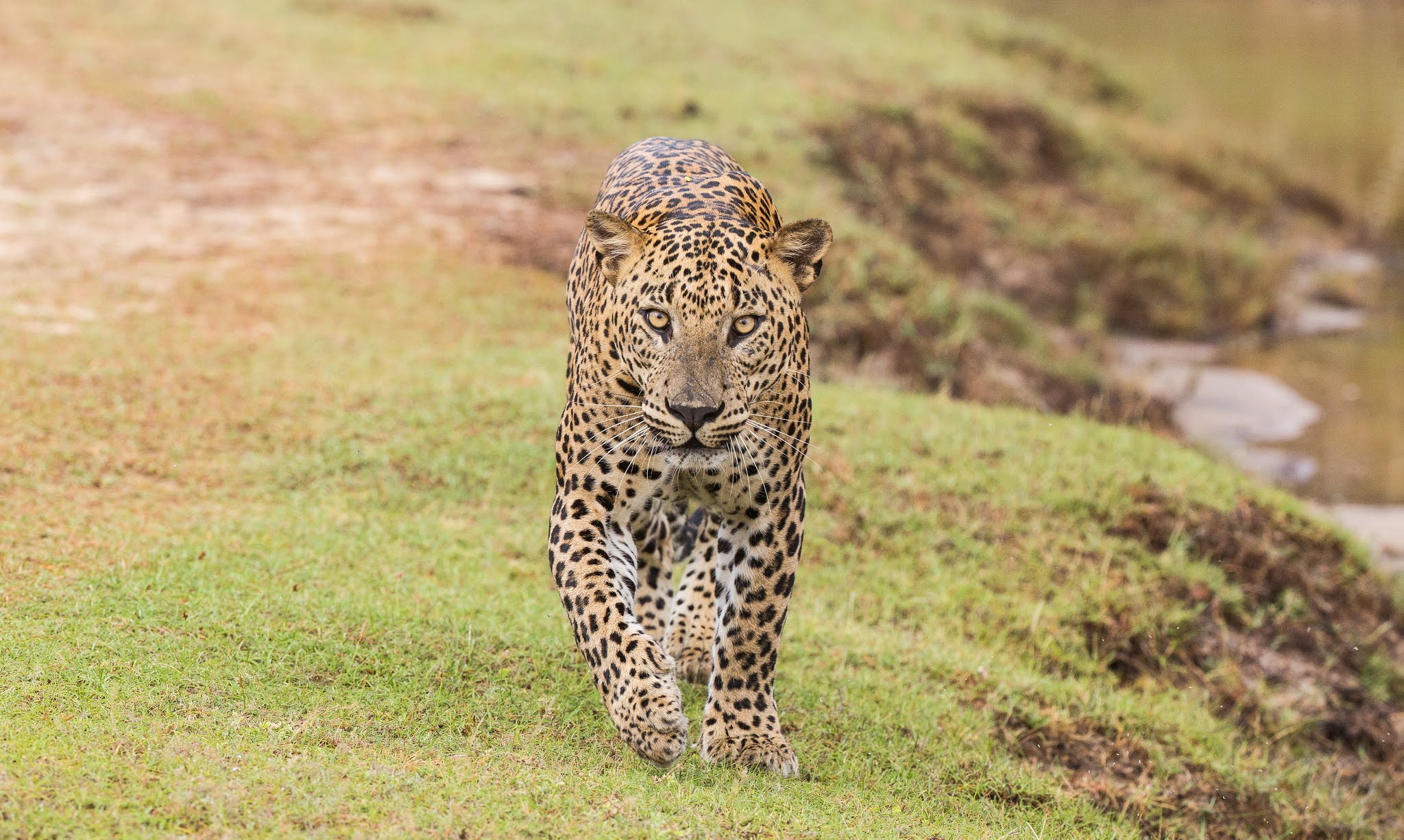
#2- Wilpattu National Park
The land of lakes, Wilpattu is
located on the North-Western end of the island. This is Sri Lanka’s largest national
park and is quite a contrast to the landscape of Yala. Where Yala is mostly
dry scrub forest, open lagoons, and plains, as well as many rocky outcrops,
Wilpattu is denser with dark forests being the dominant landscape, along with
few open spaces which are usually consisting of natural lakes known as Villus.
The dense dark forests make it quite difficult to see these predators, but when
they do come onto the roads it is a sight to behold. The open sand-brimmed
lakes are some of the most beautiful settings to view these magnificent
predators. The park was closed for many years during the time of the civil war and was finally opened to the public in 2010. During this time, the leopards
were very shy and sightings were almost nonexistent. But over time, after a few
years of continuous visitation, the leopards gradually became habituated enough
to give some great sightings. Through the years, Wilpattu has become
increasingly popular, especially with wildlife purists who seek more private and
quieter moments compared to Yala which can tend to be congested and crowded.
The chances of seeking leopards in Wilpattu is somewhat harder than Yala, but
usually, the reward of the sighting is far greater most of the time due to the
lower numbers in the park and the ability to spread out across the landscape
given the size of the park. One of the most photographed leopards from back in the
day was the infamous “Prince” a.k.a “Natta” who was a young male leopard who
was born in the Kompanchi Sampuwal/Pomparippu area and later moved around to
many parts of the park. He was at one time the most photographed leopard in Sri
Lanka, giving shows like no other, often sleeping in the middle of the road
paying no need to the on-looking people and vehicles. He was named Natta due to
the fact that the end of his tail fell off due to an injury probably with a
wild boar or another leopard. He is still alive but has been driven out to the
fringes of the park by larger and more dominant males. One of the most famous
and well-loved males of the park is the Nelum Wila Male, a massive individual
who has a large home range and is seen quite often walking without fear of
people. He is the current star of the park and one who literally poses for the
photograph. When it comes to the female’s one of the most beloved leopards has
to be “Cleopatra” the beautiful female who was known as a playful cub from
Borupanwila. Now a successful mother with her own brood of cubs is seen by
lucky visitors mostly in the Mahapatessa area with her cubs.

#3 Kumana National Park
Kumana, the land of mystery and
awe is located on the far eastern corner of the island. In fact, it is connected
to Yala and is part of the same ecosystem. But due to the access and location, it is quite a long drive to reach compared to Yala. Kumana was initially famous
as a bird sanctuary with many species of birds nesting in the waters of Kumana
Villu. But in the last decade or so, there has been an increasing number of
leopard sightings in the park. The legends say the leopards of Kumana are known
“man-eaters” and the leopards of Lenama (an area in the park) are mythically
known to be larger and deadlier. But the reality is that these too are the same
leopards that you see in Yala. But there have been cases of man-eaters in the
park which are more than in many other parts of the island. In 2019 a
construction worker was taken and eaten by a large male, who subsequently
attacked and severely injured another individual who went to retrieve the body
of the victim. Thereafter in 2020, another leopard attacked a farmer in the
nearby area of Panama while sleeping in his watch hut. The man succumbed to his
injuries. The same leopard thereafter attacked a few men on patrol at night in
the fringes of their farms. The authorities managed to capture the culprit who
was released deep inside the park which caused much controversy.
Despite these individual cases,
the number of sightings of leopards is increasing as the animals become more
habituated. The advantage of seeing leopards in Kumana is the privacy and lack
of large crowds. Given the remoteness and difficulty to get to the park has
resulted in making this one of Sri Lanka’s best-kept secrets.

#4 Veheragala (Yala Block 5)
Veheragala National Park also
known as Yala Block 5 became popular in the last 6 years as an alternative to
Yala Block 5. The small land extends borders the giant Veheragala reservoir and
is less visited than its more famous counterpart. This park is also known for
its fair number of leopards, often seen on the main road which runs through the
park. The high density of prey animals such as Spotted Deer and Grey Langur may
have resulted in the number of leopards seen, and gradual habituation has
helped greatly in giving quality sightings. This is a great park to combine
with when visiting Block 1 in order to get away from crowds and to get a change
in landscape.

#5 Horton Plains National Park
The misty highlands of Sri Lanka
is hardly a place one would imagine encountering a leopard but despite this,
historically the highlands was where most of the islands forest cover was and
where most of the wildlife animals roamed. With the onset of the British taking
over the country, they cleared these vast forests, to grow Coffee and
subsequently Tea.
One of the last remaining
highland wilderness refuges is Horton Plains, National Park. Located over 2500
meters above sea level this montane wilderness is set atop a high plateau and
is one of Mother Nature’s spectacular wonders.
Once even used by the government
at the time to grow potatoes, it was later declared a National Park and a UNESCO
World Heritage Site.
This land is one of the most
sensitive and ecologically important locations in the country with a vast
number of plant and animal life endemic and found nowhere else in the world.
The park was very popular for its
scenic landscapes and walking trails. Subsequently was highly valued as a top
birding destination to see some of the rare highland endemic species.
In the last few years, through
countless visits and patience, this too has produced some unforgettable leopard
encounters.
The kings of this domain, these
predators are found in the deep dense cloud forests and on the fringes of the
open plains which are the main landscapes of this habitat.
Feeding primarily on Sambhur the
largest species of deer in Sri Lanka these cats seem to have a few
physiological differences to their lowland cousins. The Horton Plains Leopards
seem to be much larger in physical size and their faces wider with shorter
muzzle areas giving them a stouter and wider look.
A study carried out by a a scientific team consisting of Dr Enoka Kudavidanage in 2020 has identified 23
adult leopards found in the park.
Seeing these majestic predators
is much harder than in the lowlands but with a trained eye and patience you
might have a chance in getting a glimpse of these highland beauties.


