Sunday, May 19, 2019

Into the Land of the Tiger- An adventure in Bandhavgarh National Park


On the 17th of April , myself and a group I organized through Classic Travel, departed on a memorable wildlife adventure to the heart of India , in the hopes of coming face to face with the most majestic cat in the world, the Royal Bengal Tiger.  We met up early morning at Classic Travel Head Quarters and left together towards the Airport, our flight would take us first to Delhi, and from there on we need to catch a flight to Jabalpur which is located in the state of Madhya Pradesh.

The initial flight was uneventful, but after reaching Delhi Airport, we spent around 4 hours in Transit. We are all very impressed with the modern airport and the many shops, outlets and franchises which the airport had as well as how well organized and clean the whole place was.

Our next flight was in a much smaller propeller driven plane, and the flight was quite bumpy and uncomfortable given the size of the craft and the prevailing weather. As soon as we took off from Delhi, it began to rain hard, and I was worried at that instance whether the rains would affect our safaris. This was a worry which I had throughout the flight.

We reached Jabalpur late in the evening, and were welcomed outside with a fleet of luxury SUV’s which would take us to Bandhavgarh our stay for the next 6 nights. The journey was 3 hours long, and it was in the night hence we couldn’t observe much of our surroundings. In fact we were quite hungry, given we didn’t have lunch, and were awaiting our meal in our lodge.

The hotel we stayed in was Monsoon Forest Lodge, which is owned by our Indian ground partners who work with us very closely, and hence had 100% confidence we will be well looked after. Upon passing the last big town Umaria, we drove through the park which is separated by this carpeted road. I saw the boards of Magadhi and Khitauli zones which we would be visiting the next day. Upon reaching the small town of Tala, we went off on a dirt road which led us to our lodge. We were given a warm welcome by all the staff at the car park and greeted by its General Manager Deepak. Walking through the paved path led us to the main lodge, a rustic and tastefully designed building, which used natural material and lovely architecture. Being very hungry we went straight away to the dining room. We were served a delicious piping hot meal, after which we retired to our rooms. The rooms were amazing, and my chalet was located close to the lounge building. It was a nicely designed structure with a direct view of the wilderness. The rooms were large and spacious and tastefully designed. After a quick wash, I went into a deep sleep, but only for a few hours as we were to wake up at 4.00 am the next day for our safari.

The alarm went off, but I wished I could have slept longer, given our tiring day before to get there. Half asleep, I walked to the main lounge with my camera gear. So to give an outline of the set up on how the safari system works, we pre book our slots well in advance. The demand for safaris in April is so high these slots get booked up almost within seconds. Hence we were lucky to get most of the best slots.

Gathering at the main lounge, we headed to the car park where our jeeps were waiting for us. These are small Maruti Gypsy’s which can accommodate 4 passengers comfortable. All set and ready we set off on our first game drive. I joined my client Udara’s jeep, and headed for Khitauli zone. Along the way we have to pick up a guide which is compulsory on the safari. Passports are inspected at the gate and in we went. The park was very different from what I was used to in Sri Lanka. The landscape was filled with Sal Trees, and much greenery. We came to a beautiful meadow which was lovely in the morning mist. We kept driving to many areas and the landscapes too kept changing. Some areas were covered in bamboo. The park was well populated with Spotted Deer and Grey Langur, primary herbivores which are also prey for tigers. Also we spotted quite a number of Sambhur and Barking Deer.


I was very tired, and at times drifted off to sleep, given how tired I was after having virtually around 4 hours of sleep for the last two days. Suddenly at one point the jeep came to a halt, and the guide told us hes spotted some “Blue Bull”, which I knew immediately were Nilgai, these are massive antelope which are endemic to the Indian Sub-continent. They are large animals the size of a big bull and very close relatives of the Eland of Africa. There were around 4 individuals to be seen and we noticed 2 more quite a distance away. Still no tiger, and hence we continued until we came to a location where we got news a patrolling elephant (the park uses elephants for patrols to monitor tigers), has spotted a tiger and hence we waited for about 30 min hoping the tiger would appear. But as there were no signs we headed to the designated picnic spot for breakfast. Afterwards we headed back to the same spot, to find a horde of jeeps lined up. We knew there was a tiger, and after making our way in the crowd we got our first glimpse of this majestic animal. It was a young male, and was sleeping in the small ravine below. We couldn’t get a clear photograph, hence we admired the animal with our eyes and waited. As we waited the tiger moved giving us a view of his face as he turned to look at us. We managed to get a few images but the light wasn’t great’. We waited in the same location for over 2 hours and the sun was getting very hot. At around 10.30 AM we decided to leave the sighting and head back for some rest. I was exhausted and so was Udara. We reached the lodge at around 11.30 AM and in the scorching sun we headed to our rooms for a much needed nap.


Refreshed after our sleep we met up for lunch at the lounge. The rest of the group have had lunch and were resting. We got to know they all have had some fantastic sightings in the Tala Zone which they all went to. I was very happy that everyone got some good tiger encounters.

The afternoon safari begins at 3.30 PM. I joined my parents (who also joined this tour as customers), to the Magadhi Zone for this safari. The Magadhi zone is very beautiful, far more than Khitauli. With some amazing meadows sprawling with deer and stunning back drops of a massive rock where the historic Bandhavgarh Fort is located. We came across a gathering of vultures, which included as many as 4 species such as the Griffon Vulture and King Vulture.


After a few hours of searching we came to a tiger sighting. A young tiger was enjoying the water of a small waterhole made by the park for the animals during the dry seasons. After a few minutes another tiger joined. Both enjoyed the water for a very long time, and we observed both of them for over 2 hours. These were two of the three cubs of Dotty, a well-known tigress. As this was out in the open, the sighting attracted many jeeps. Some of our jeeps drove ahead and had encountered the third cub with the mother Dotty as well as seeing a large male named Bamera’s Son. Heading back it was very dark and we just missed a tiger crossing the main road from the Magadhi side to the Khitauli zone.
Back at the lodge, it was a lovely setting to meet at the lounge with everyone, and discuss about the days sightings before dinner. Our meals were delicious and prepared using fresh ingredients from their own organic garden.


The next day was a venture for me into Maghadhi Zone once again, this time with Dallas, Christine and Puny. There were many of the usual herbivores such as Spotted Deer, Grey Langur, Rhesus Macaque and many species of birds but unfortunately no tiger sightings. In the evening I set out to Tala Zone for the first time. I was truly amazed about the varied landscape of this zone. We took an uphill rocky road, which was bordering some deep gorges, and rocky outcrops. The landscape was truly surreal. Along this road, we came across a leopard darting across the road. This was such a rare find in this park, as the tiger being the dominant predator in the eco system means the leopards are very shy unlike in Sri Lanka.


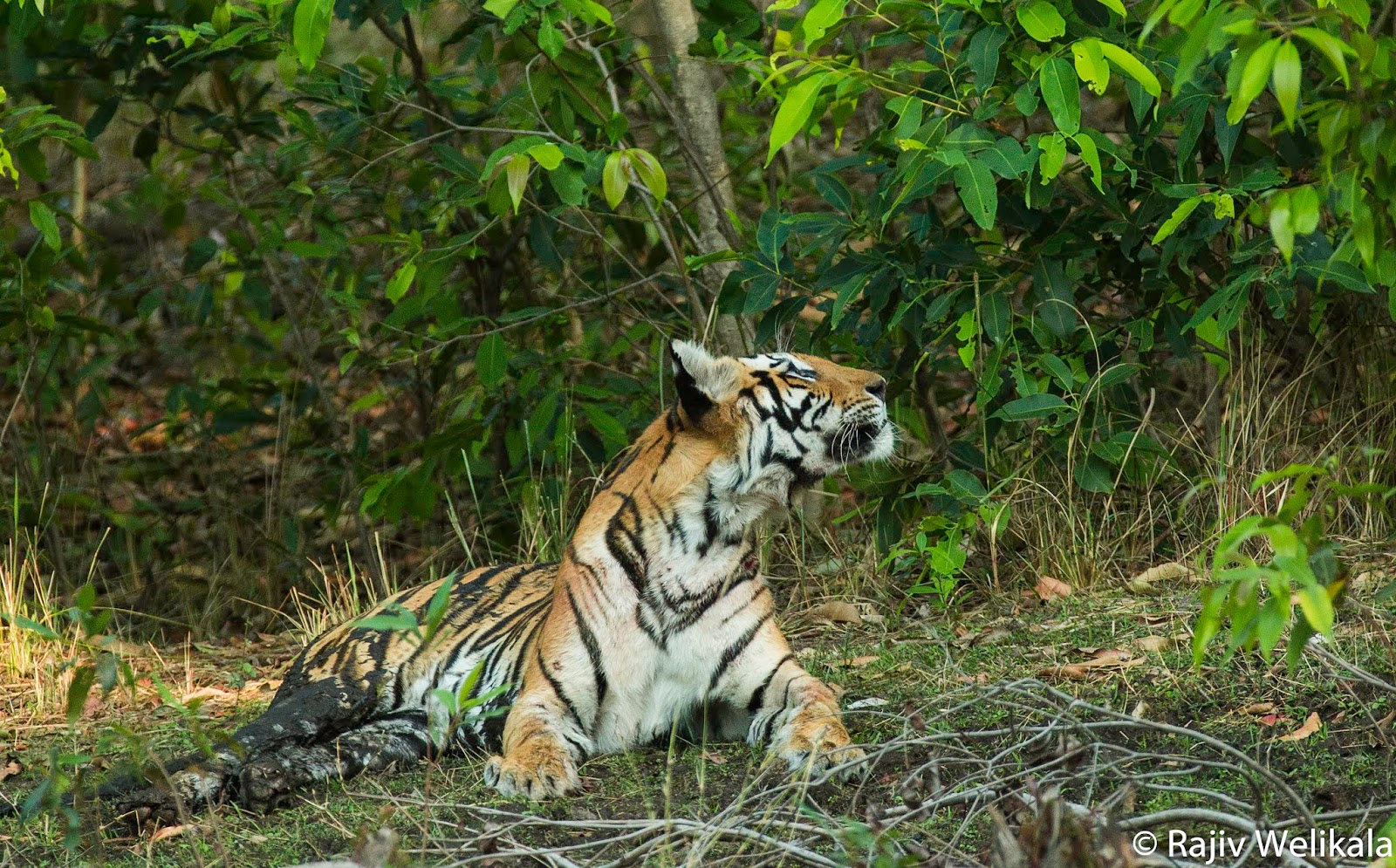
The safari led us to a small pond close to the road, where an injured tigress named Bhanbei was resting. She had a wound on the shoulder and the park vets were monitoring her as she had three small cubs. One of the other jeeps of our group were lucky to have seen one of the cubs in the water just before we arrived.


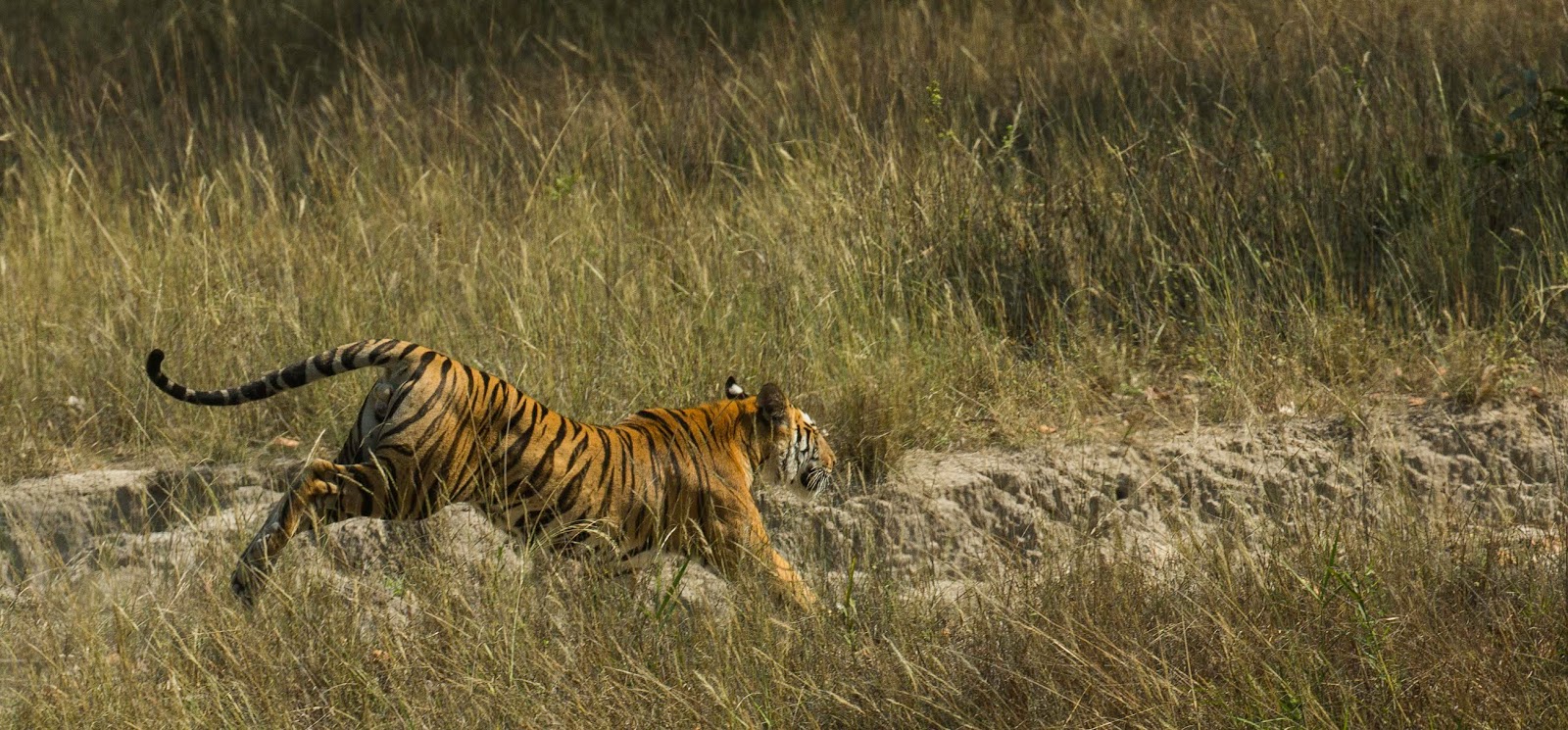
The next day, was spent in both the Khitauli. zone as well as Maghadhi Zones. In Kitaouli, we came across a young male tiger dashing across the road and into the woods on our right. I managed to get some nice action photographs of the beautiful cat running. We did have some sightings of tigers in Magadhi , two of Dottys cubs which were around six months old and three small cubs up on a rocky outcrop which were around three months old, and were the litter of a tigress named Solo. Photographically they weren’t the best sightings. Dallas and the group had come across two fantastic sightings that morning in Tala Zone. One of a large male named Bamera’s Son who had given a lovely performance to the group with some amazing close ups, plus a hunting sequence by Spotty a famous female in the park. By far, Dallas’ jeep was always very lucky, except when I went with them.


That evening the lodge organized a special dinner for us under a Banyan Tree further into the wilderness. It was a lovely setting and decorated with lanterns, as well as a nice bon fire. The special occasion was to celebrate Christine’s birthday. We had a lovely dinner, as well as a nice surprise cake from the lodge for the birthday girl. During the entire dinner, we were entertained by the constant call of the Common Hawk Cuckoo which was roosting on the Banyan Tree, and giving out a loud call nonstop. The bird was called the “Brain Fever” bird due to its nonstop calling. After a lovely evening we went to bed late that night, but with alarms set for next day’s safari.

I ventured to Tala Zone, and despite trying very hard, we weren’t that lucky to see any tigers that morning. I did manage to photograph a giant Gaur Bull, also known as Indian Bison, these massive animals are the tallest species of wild cattle in the world. The big males have a large muscular frame and are quite impressive. The bull we came across was in peak condition and was calling for the other females who were grazing in the meadows.


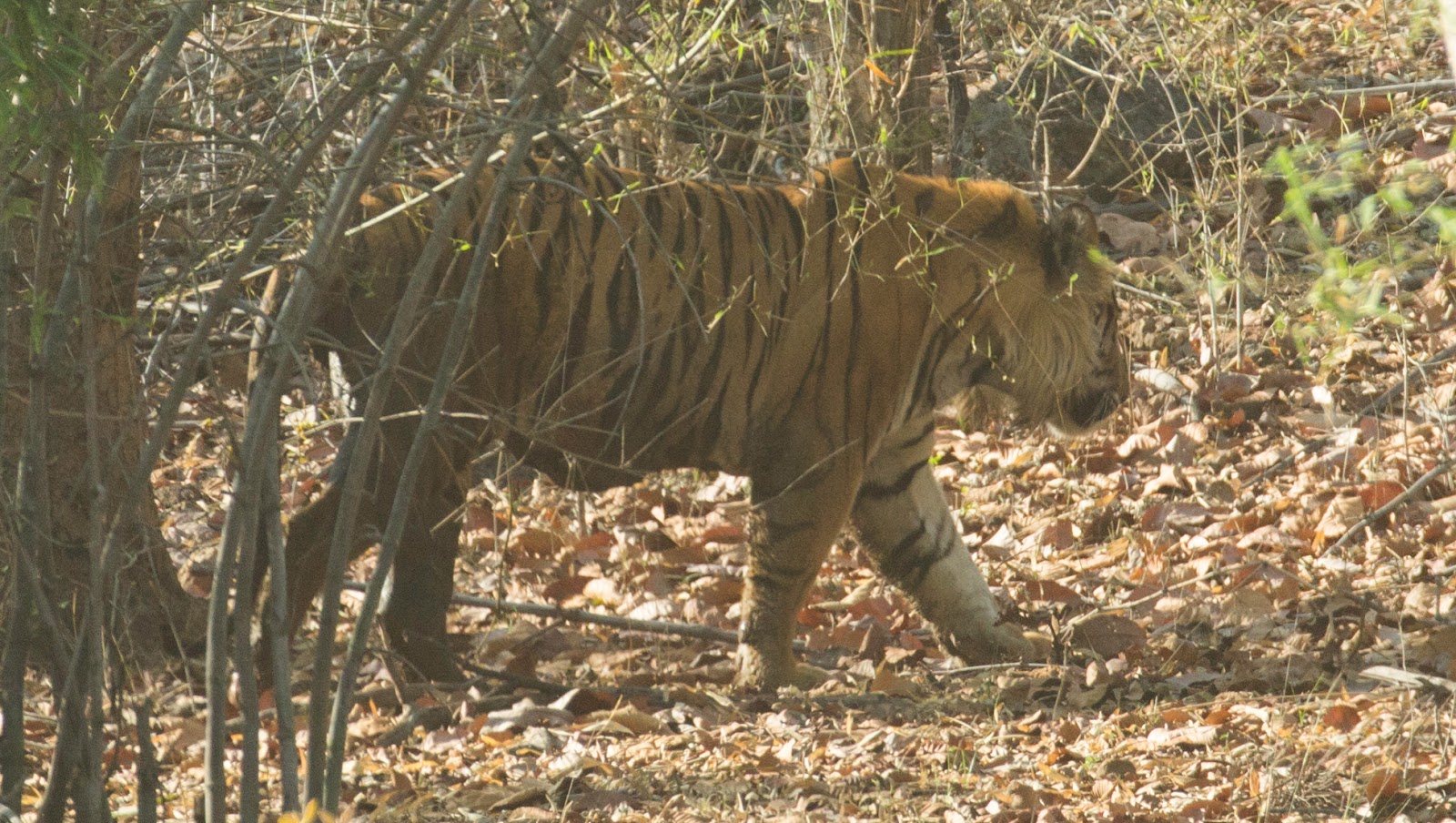
 On our return to the lodge, we were met with shocking news of the attacks back at home. Initially thinking it to be a joke, we took a long time to realize this was all real. Our entire mood of our trip was ruined. In the evening with heavy hearts we decided to continue our safari as “life has to go on” and hence  I went into Khitauli. Zone as we had got news that the biggest tiger in the park Bheem was seen there. So we set off with high hopes, and did end up finding this famous tiger. There were a few jeeps, which made getting a clear view of him quite difficult, but I did manage to grab a few images of this giant tiger through the vehicles. He was wallowing in a small puddle, and his sheer size was mesmerizing. He was easily the largest cat I have ever seen. Much larger than any of the African Lions I had seen in my previous travels. This massive male had a large scar across his nose, and had tufts of hair on his cheeks resembling a mane. After a while, he rose up and walked into the deep forest. We saw him walking in a distance, and hoping we can intercept him, kept driving up and down on a road we hope he would cross. But we waited till 6.00 PM and he didn’t cross, hence we retired back to the lodge, at least with some satisfaction that I saw him.


Our spirits were down that evening, and was far from the good laughs and cheer we had the previous few nights.
The next day would be our last, and hence we wanted to make the most of our safaris. We came across a tigress crossing the road, by using one of the small pipes/tunnels set up under the road to allow excess water to flow. This was said to be one of Bhanbei’s adult daughters. I also was lucky to photograph an Egyptian vulture which is a beautiful bird despite being from the vulture family. Before breakfast we came across Spotty, one of the most beautiful tigress’s I had seen lazing in the grass some distance away. After about 20 minutes she slowly walked into the interior, where she drank water from a stream and settled down quite some distance away.


In the evening we were back at Tala Zone, and after searching for some time, came across Spotty resting in a waterhole. There was quite a significant crowd, but we managed to get ourselves a nice spot. After around 20 min she came out of the water and started walking along the road ahead. The jeeps all scrambled to get a good position, but the best thing to do at that moment was to enjoy the sighting. She was at complete ease and oblivious to all the jeeps clamoring behind her. She even sad down on the road for a few seconds before slowly slinking into the forest. We were extremely happy to have this as our last sighting.


We headed back to the lodge one more time, and spent the night in reflection of our encounters and good times we had. Sadly we were not going back home to the Sri Lanka we left it, but a country broken and hurt. But nevertheless it was home.


The next day I had news that our domestic flight was to be delayed and hence we were worried on not catching our connecting flight. Despite our worries, when we landed in Delhi, it was already 30 min after the scheduled departure time for our Colombo connecting flight, but still the plane was waiting for us. Hence we all rushed and ran like we have never done before, and sped through security to board our plane. The flight waited all this time for us thankfully and after what seemed like ages, we landed back in our home. Sadly it was a stark contrast to the Sri Lanka we left. The airport was empty, and the security was very tight. We reached our homes tired and yet relieved to be back with our families. Now, few weeks after, I am reflecting on our memories and good times, and hence have decided that despite whatever comes our way, we will not let these stop our way of life and our love for travel, adventure and exploration. The tigers of Bandhavgarh mesmerized me, and the wilds of India are calling me even now. I know I will be back, and my love affair with the mighty tigers of India is just beginning.


Friday, January 18, 2019

The Last Mammoths on Earth- Big Tuskers of Africa


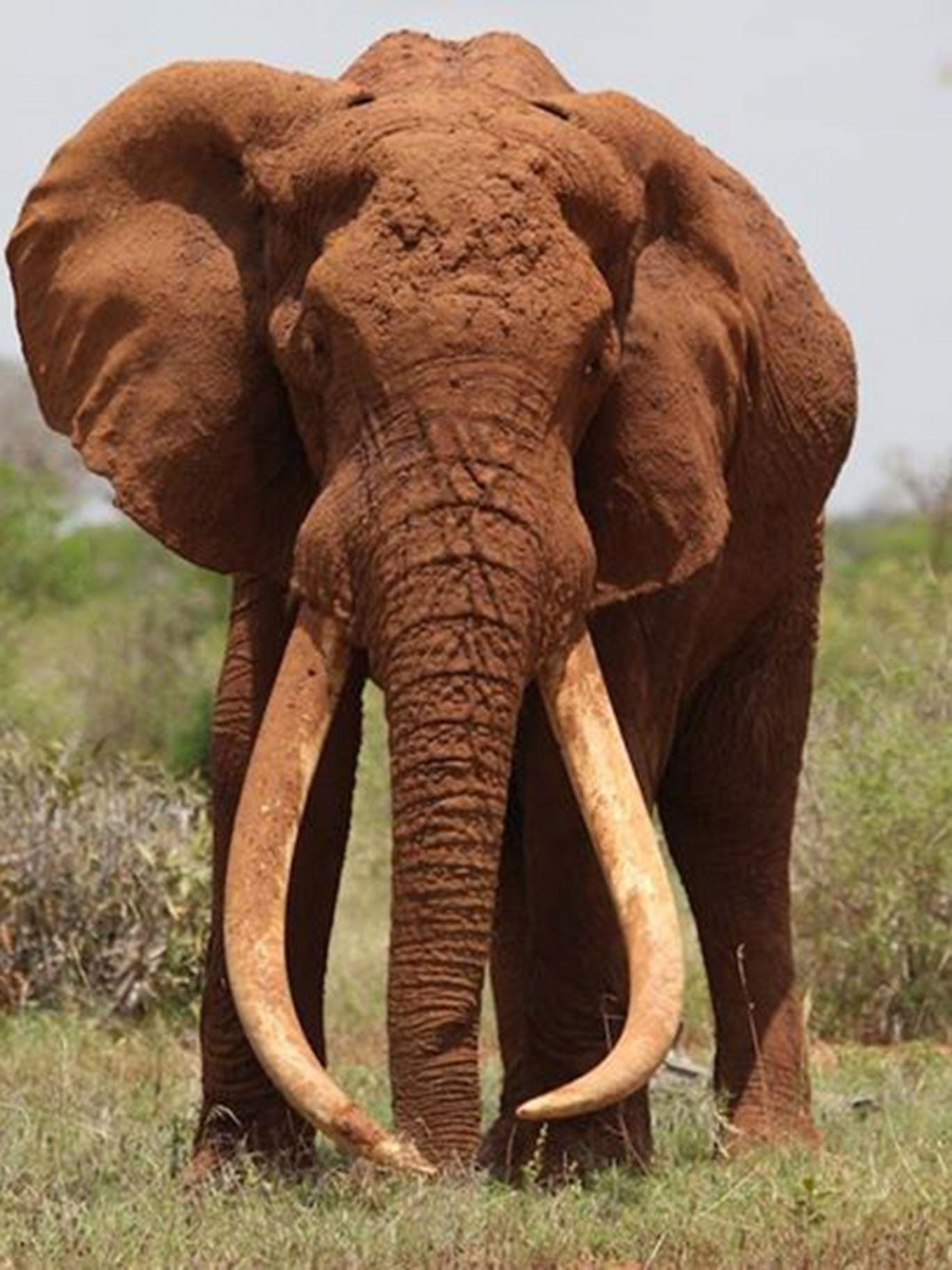
In Sri Lanka the term tusker is synonymous with any male elephant carrying ivory, be it large or small. Seeing a tusker in Sri Lanka is indeed a rarity, as only a small percentage of males on the island carry the genes to produce tusks. But in the continent of Africa it is very different, as the African Elephant, in both Savannah species (Loxodonta Africana) and the Forest Elephant (Loxodonta Cyclotis) the male and female animals carry ivory. The bulls invariably are bigger and in turn carry larger heavier tusks. But an average elephant is not referred to as a tusker in Africa, this moniker is rather given to very special bulls who are at the peak of genetic superiority and physical condition, enabling them to grow large heavy ivory which weight at least 45 kg per side, and at times almost touch the ground. 

The sight of a giant bull with amazing shafts of ivory is a sight to behold, as usually the males with the best genetic stock tend to have this trait, and hence are physically impressive specimens. Around two to three centuries ago such majestic bulls were found throughout the continent, these were the prime breeding bulls and most desired by females to father their calves and carry on their genes to the next generation. Sadly with the onset of the white explorers came trophy and ivory hunting.  Invariably the prime target were the elephants with the biggest tusks. This systematic selection of hunting was practiced not only by the big game hunters but also ivory traders such as Tippu Tip who was a powerful ivory and slave trader from Zanzibar. It was one of his slaves who killed a bull with the largest pair of tusks in the world. Shot in the foothills of Mount Killimajaro, this bull carried a pair of ivory ,one weighing 107 KG and the other 102 KG. 

Image result for Kilimanjaro tusks
Killimanjaro Bulls Tusks- Photo credits- A.C Gomes & Co

Later with the independence of many African nations, mass scale slaughter was rampant which further cut down on the population of big tuskers. By the latter part of the last century only a handful of true “Big Tuskers” remained. Historically these bulls were found in certain regions of South Africa, Zimbabwe, Mozambique all in the South of the continent, as well as in the East African regions of Kenya and Tanzania along with certain regions of the Congo, namely the Lado Enclave which was known as the prime hunting grounds for giant ivory by the Big Game Hunters of old. Historically, elephant populations in Botswana and Namibia never produced big tuskers of significance, as this is also depending on the type of food and nutrition the elephants have in their habitat.

In South Africa, in the 1970’s there were seven bull tuskers with immense ivory over 50KG per pair in Kruger National Park. These majestic bulls were dubbed the “Magnificent Seven” by the then Chief Warden Dr U de V Piennar as an example of successful conservation work. These legendary tuskers roamed the various regions of this gigantic park and passed on their genes onto the next generation. Some of these famous tuskers are Mafunyane, Shawu, Joao, Shingwedzi and Ndluthamithi. Some of whose ivory are still on display at the Elephant Hall in Letaba Rest Camp. 

Image result for Mafunyane tusker

Mafunyane, one of the Magnifficent Seven. Photo Credits- Anthony Martin Hall

Image result for Mafunyane tusks letaba

Elephant Hall in Letaba, Kruger Natinoal Park

Letaba Elephant Hall re-opening-Kruger-Court SANParks-2

Elephant hall in Letaba, Kruger National Park

These giants all died by the end of the 1980’s but thereafter their decedents roamed the park, with equally magnificent specimens such as Tshokwane who famously gored and almost killed wildlife photographer Daryll Balfour, Duke who was arguably one of the most handsome with symmetrical ivory, and Mabarule who suffered for many years with severe arthritis which was discovered later from his bones and was assumed to have been in intense pain most of his adult life, and yet even these legendary bulls are no more. A new generation of up and coming tuskers are recorded, but are yet to match the might and majesty of the giants of old. 

Image result for Tshokwane charge daryl balfour

Tschokwane of Kruger National Park taken while charging and almost killed the photographer Daryl Balfour. Photo credits- Daryl Balfour

In Zimbabwe, there was the famous Chura Bull from Matusadona National Park in the shores of Lake Kariba, who was also featured in the Clint Eastwood movie “White Hunter, Black Heart” in 1990.

Image result for chura bull zimbabwe

Chura Bull who starred in the Clint Eastwood movie- White Hunter Black Heart  Photo Credits- Chris Worden

Moving onto East Africa, the most famous tusker of old would have to be Ahmed from Kenya. He was arguably the most famous tusker in the world at one time and declared a living monument by the then President Jomo Kenyatta and provided two guards to protect him around the clock. Ahmed roamed the forests and plains of Marsabit National Park and was known more by reputation rather than sight. He had the most magnificent pair of tusks which were beautifully symmetrical. Born in 1919 he passed away in 1974 at the age of 55 years. His massive tusks weighed 67 KG each and his skeleton and ivory is on display even now at the Kenya National Museum in Nairobi. 

Related image

Ahmed the mighty tusker of Marsabit National Park, Kenya. Arguably the most famous elephant in Africa. Photo Credit - Mohamed Amin

Looking at the current day and age the fate of these big tuskers is very bleak. Around a decade ago there were an estimated 40 such magnificent bulls roaming around the plains of the African Continent. Right now less than half of that number remain and are disappearing rapidly. Most elephants now carry small ivory and in some parks have evolved without tusks as well, which gives a biological advantage in areas ravaged by poaching. The demand for ivory is ever increasing, especially in the China and now due to the lack of big bulls with large ivory even young elephants with very small tusks are killed, all to create lifeless trinkets which are worthless in comparison to the animal who carried them.

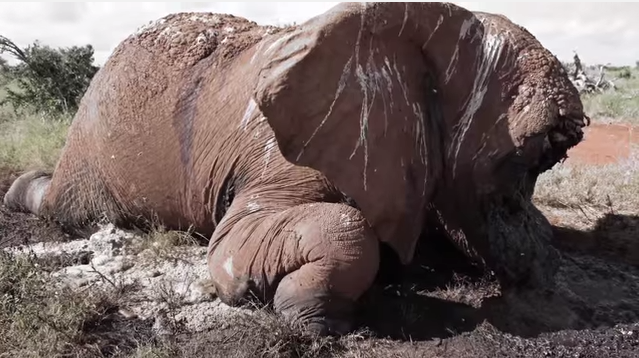
Out of the places known to contain such massive tuskers, Tsavo and Amboseli come to light. Tsavo is Kenya’s largest national park and is a giant tract of land of approximately 21,000 square Kilometers, which is estimated to contain over 12,000 elephants in its eco system. Out of which a small handful of bulls are “Big Tuskers” with giant ivory. Sadly some of the most well-known iconic bulls have fallen prey to poachers, mainly those who cross from the Somali border. Bulls such as Satao and Satao 2 both fell to the poison arrow of poachers. Protecting these bulls is a herculean and almost impossible given the land extent, but is yet carried out tirelessly by the Tsavo Trust which is a field based NGO, with constant monitoring and action to protect these last remaining giants. Unfortunately it seems like a losing battle but yet they continue to fight on.

Image result for satao elephant
Satao, Tsavo's most iconic tusker who was brutally killed in 2014- Photo credits- Tsavo Trust

Image result for satao elephant

Butchered body of Satao. Photo Credit- Tsavo Trust

Amboseli National Park which is a much smaller eco system but yet historically linked to Tsavo via the Chyullu Hills is home to the most studied wild elephants in the world. Research pioneered by Dr Cynthia Moss in 1972, provided detailed findings on elephant biology, behavior and society. She systematically named and identified every individual elephant and their families and has records and data of elephant families spanning many generations. Another well-known researcher and scientist Dr Joyce Pool who started working with Dr Cynthia Moss and was fundamental in discovering the phenomenon of musth which was once thought to be a condition only Asian Elephant bull’s went through, but concluded as present in African Elephants as well. Dionysus was one of the most famous bulls during the late 80’s and 90’s had beautiful wide swept ivory and was also featured in the documentary Echo and the Elephants. Presently there are three known big tuskers in the park. The most famous of which is Tim, who is from the “T” family and son of Trista named by Dr Cynthia Moss, and is arguably the most famous elephant in Kenya at the moment. His left tusk is long and reaches the ground, while is right tusk is short and curved inwards giving him a unique appearance. He is also a massive animal and towers above his fellow bulls and is estimated to measure 3.4-3.5 Meters at the shoulder and weigh almost 6 Tons. The other two living bulls are Craig and Tolstoy who is by blood Tim’s uncle but is younger than Tim by two years and shorter in stature. Craig looks almost identical to Tim in tusk shape, but is shorter in stature and is thought to share the same father despite being from different mothers. Amboseli being next to the Tanzanian border and on the foothills of the great mountain Killimanjaro means these bulls might even be descendants carrying the genes of the giant bull shot on the slopes of this great mountain and who holds the record for heaviest tusks to date.

Mount Killimanjaro, seen from Amboseli National Park. Photo by Rajiv Welikala

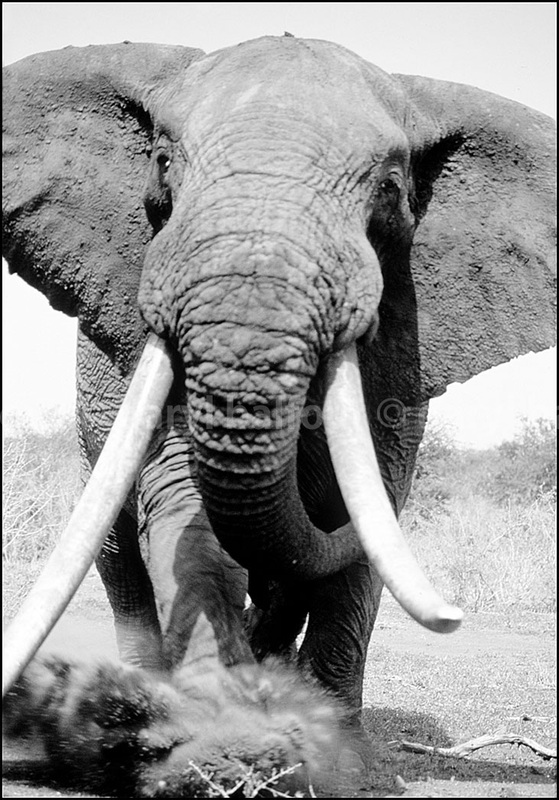
My lifelong dream has always been to photograph one of these iconic African Big Tuskers. With this dream in mind I set off to Kenya in 2016 with high hopes of catching a glimpse of one of these last mammoths of the Africa of old. I knew time was running out and it is a matter of time that we will no longer have such awe inspiring animals left on our planet, and hence it was imperative that I somehow see one before it is too late. Little did I know it was going to prove harder than I imagined to find Tim who I desired to see the most. With information received from various sources that Tim is in the park during the time of my visit as he was in musth, I set off from Nairobi on a long an uncertain journey to Amboseli. The park was initially overwhelming, for someone who has never been to Africa before, the sight of such abundance of wildlife is astounding. Elephants are everywhere and found in their droves, from the many herds scattered across the park to lone bulls feeding in the marshes. On my first day itself I managed to identify Craig who was feeding deep in the marshes close to Ol Tukai. It was very far away, but I was able to identify him from his torn ear and shape of tusks. I was very happy at seeing him, and yet yearned to see his bigger and more majestic counterpart in Tim. The days passed by as we kept searching the park for this elusive bull. This is easier said than done, and I literally scanned and observed every single elephant I could see in a 360 degree radius in order to identify if he was Tim. One the third day at around 10.30 PM when the sun was very bright, I caught a herd which was far away in the swampy marshes. The light was very harsh and hence it was very hard to focus, but I noticed a gigantic bull trailing the herd and from the shape of ivory I immediately identified who he was. Unfortunately they were so far away and deep in the swamps that we were unable to get close enough even for a decent photograph. Extremely disappointed I headed back to the lodge to wait till the light gets better by afternoon and hopefully catch a hold of him. But when we returned a few hours later he was nowhere to be seen. I scanned the whole area in vain and must have observed around 100 elephants one by one and yet couldn’t identify Tim. The days passed and I had made up my mind that I will not unfortunately see Tim, and was trying to convince myself to be content with seeing Craig. On the last day of our tour, on the last morning safari, we set out in the park, with no real hopes of seeing Tim, but rather maybe to try and find some lions. As the light was getting better, I noticed a herd of elephants in the distance, and for what it’s worth told my driver to stop the van so that I can scan and check the herd out. To my disbelief there he was! Tim, the mighty bull who I was chasing all this time, grazing peacefully and following the herd of females and calves. He towered above the rest and was quietly following the herd while keeping a distance. My heart was pounding as he approached us slowly, my hands were shaking and I was barely able to keep them steady to keep firing camera. His true stature and might was evident as he was mere meters from our van as he towered above us. Paying no heed to our presence this mighty bull with the most magnificent ivory I have ever seen, peacefully crossed the road in front of our vehicle and continued on his way towards the marshes and the herd. It took me a good hour or more to bring my adrenaline down, and I felt jittery with excitement for the entire day knowing I had fulfilled the biggest dream of my life. Also deep down I felt a sense of sadness that this maybe the last of a noble line of giants who will cease to exist in the coming generations, all because of the greed and negligence of man. 

Tim from Amboseli. Photo Credits- Rajiv Welikala

Craig from Amboseli. Photo Credit- Rajiv Welikala


Big Tuskers are a remnant of an Africa of old and of days gone by, and sadly will end up as nothing more than a part of old tales and legends of a time once upon a time when mammoths roamed the earth.

Tim with other elephants in Amboseli . Photo Credits- Rajiv Welikala


Bibliography

Africa Geographic Magazine. (2019). Africa's Big Tuskers - Africa Geographic Magazine. [online] 

Available at: https://magazine.africageographic.com/weekly/issue-96/africas-big-tuskers/

Africa Geographic Magazine. (2019). The silent giants of Tsavo - Africa Geographic Magazine. [online] 

Available at: https://magazine.africageographic.com/weekly/issue-119/silent-giants-tsavo/

Africa Geographic Magazine. (2019). R.I.P SATAO 2 - Africa Geographic Magazine. [online] 

Available at: https://magazine.africageographic.com/weekly/issue-141/rip-satao-2/

Alberts, E. (2019). People Just Killed One Of The Last 25 'Big Tusker' Elephants. [online] 

The Dodo. Available at: https://www.thedodo.com/in-the-wild/big-tusker-elephant-killed-kenya

BBC News. (2019). Rare 'giant tusker' elephant killed. [online] Available at: https://www.bbc.com/news/world-africa-39188184

Bosman, P. and Hall-Martin, A. (1994). The magnificent seven and the other great tuskers of the Kruger National Park. Cape Town: Human & Rousseau.

Capstick, P. (2013). The last ivory hunter. New York: St. Martin's Press.

Gilbert, N. (2010). African elephants are two distinct species. Nature.
Marais, J. and Hadaway, D. (2012). Great tuskers of Africa. Cape Town: Penguin Books.

Poole, J. and Moss, C. (1981). Musth in the African elephant, Loxodonta africana. Nature, 292(5826), pp.830-831.

Tuskersofafrica.com. (2019). Tuskers of Africa. [online] Available at: http://www.tuskersofafrica.com/

Ward, R. (1986). Rowland Ward's records of big game. San Antonio, Tex. (9601 Broadway, Suite 201, San Antonio 78217): Rowland Ward Publications.


Wednesday, May 2, 2018

Bison tracking in Poland

The Wisent, or European Bison. Very little is known about this enigmatic mega herbivore. Many Sri Lankans wouldn't even know there was bison in Europe. But this is the largest land animal in Europe and has been roaming the dark forests of the continent for millennia. This is proven with the many cave paintings by our ancient ancestors depicting hunting bison.

With a bull standing 5-6 feet at the shoulder with a weight of 800-1000 kg these are truly majestic giants. Sadly the amazing species almost faced extinction in the wild. In 1919 the last wild Wisent was shot, and only a scattered population remained in zoos. Genetic studies proved that only 6 of the captive Wisent were suitable for breeding. These survivors became the ancestors of the now surviving wild Wisent. After two bulls were successfully released in the Bialowieza Forest in 1952 and followed by two cows the following year, in 1957 the first European bison was born in the wild.

Today there are over 3,000 wild European Bison scattered across the continent. Seeing such a magnificent animal in the wild was always my dream. My goal is to witness and photograph the great mega fauna of this planet, and hence the Wisent or European Bison was the top of my list.

Bialowieza is one of the last European primeval forests and a massive expanse of woods spreading between Poland and Belarus. This is an immense forest expanding to over 141,885 hectares, and one of the last refuges for mega fauna such as Bison, Moose, Red Deer and predators such as Wolf and Eurasian Lynx.


There are over 600 Bison living in this forest eco system, but as they are mainly forest animals, it is not very easy to find them. I was heading to Poland on a work assignment, and as usual I read up about the wildlife to be seen in this country, with little expectation of finding any mega fauna. But to my surprise I read up about Bialowieza and immediately made my plans to visit this forest after my work is done.

I wrote to many experts and photographers in the area, and all confirmed that April may not be the best time to see them, and that its not easy to find these giants out in the open. But given that I am already in the country I decided to make plans and give it a shot.

Hence after a stressful week of travelling to many cities such as Poznan, Warsaw, Krakow and Gdansk, I finally was ready to head to the far East to seek my quarry the giant European Bison.

I was joined by my Polish friends Adam and Kasia, who met up with me at 10.00 am on Saturday to take me all the way to the forest. En-route we passed many charming villages and countrysides. Poland has a whole has alot of forest cover, and hence we passed many forest patches along the way. Our discussion were about the bison, and even Kasia confirmed that despite the fact that she has visited the area many times she has never seen a wild bison. Hence we were quite pessimistic on our journey, but nevertheless wanted to enjoy nature and have a good time.

Reach the town of Hajnowka, we turned off towards the village of Bialowieza, which passes the ancient forest on both sides. En-route Adam wanted to visit a local zoo which housed few of the wildlife specimens in enclosures. I was not too keen, but as he was interested we obliged and went ahead. As with all zoo's we were presented with large enclosures of wildlife in enclosures, sitting in one place, and not looking too healthy. This was not what I had come to seen and hence we did a quick round and headed back out.

En-route I jokingly told Kasha "what if we see bison by the side of the road in the forest" and to which she replied saying "its never going to happen". It didnt take us 10 mins after this conversation, when I noticed some cyclists who have stopped their bicycles and were taking photos of something in the forest with their phones. Then I saw through the trees there was a bison grazing in the forest. I shouted out to Adam to stop the car at once, and I jumped out, and ran to the boot to grab my gear, and walking into the forest towards the cyclists.

When I reached there, my hands were shaking with excitement, I was finally face to face with a real Wild European Bison ! I started clicking away, and I was only around 20-30 meters from this bull. The light was abit harsh as he was out in the open, and the bison was a young bull which hasn't fully matured. He looked at us, and then started rubbing his head and horns on a tree stump. After taking my pictures, I noticed another bison much deeper in the forest. From the darker coat I realized this was a much bigger animal, and also the forest looked much nicer for photography, hence I slowly walked my self around the forest, and deeper inwards to get a nice angle to see this giant.


What I was facing was a fully matured bull, which a gigantic structure and large horns, exactly how I had imagined these animals. A majestic behemoth fitting the role of "King of the Woods". This giant bull was easily 5.5-6 feet at the shoulder and would have weighed between 800-1000 KG. He looked at me head on, and the sight in front of me was amazing, the typical Bialowieza forest full of trees as a backdrop along with the newly bloomed spring flowers on the ground, which gave an almost mystical picture for my camera. I started clicking away, trying to ensure I get as much of the habitat as well. The bull kept watching me, and after about 5-10 minutes, I decided to slowly walk backwards, not to startle it, as we have to remember these are wild animals and can turn aggressive. My heart was racing, and my adrenaline pumping, this was an amazing sighting which was beyond my wildest expectations, and especially so early into the trip. Our car stopping along with the cyclists brought more attention and an increasing number of people were coming to see this spectacle, mainly to see the first bison which was more out in the open. After around 15 minutes more, both animals slowly made their way deeper into the forest.


I was overjoyed and elated, and in utter disbelief in what I had just experienced. I still couldn't fathom that I was so lucky to see these bison, so close to the roadside and even before we had officially reached the town and started our tour with the wildlife guide. We reached the Bialowieza town thereafter and checked into our hotel, before meeting up with our wildlife expert and guide Pawel. He was very knowledgeable and had a deep understanding of the forest. We discussed for over an hour about Bialowieza before heading out with him to cover some of the main areas of the forest. We passed many meadows, where we looked out for more bison as well as other wildlife. Unfortunately we didn't spot much except some roe deer and a lesser spotted eagle far away. I wasn't worried at all , as I had achieved the main target of the trip, and hence discussed on plans to come in a different season and spend more days exploring this unique forest.

The next day we explored the many historical and cultural places in this town. I read that Bialowieza was the chosen hunting reserve for the Russian Tsars who even had an imperial palace in this area. Many of the guest houses and motels are old hunting lodges, with charming decor and memorabilia. There are some amazing restaurants serving some amazing polish food. The forest trails and pathways are many in this area and being the weekend attracted many Polish and foreign visitors to this region.

The bison, known as Zubr in Polish is iconic in this area, with many places, drinks and monuments in its name. The most famous was the Polish vodka Zubrowka, and beer named Zubr which are very popular in this area.

The famous Bison Grass Polish Vodka
And the Zubr Beer ! Zubr means Bison in Polish

Celebrating my sighting with Adam

And Amazing Food !!!

Traditional Polish Dumplings called Pierogi


Even in the capital city, there are many emblems of the bison used in corporate such as banks, which shows who deep the Bison is etched in Polish culture.


Statue of an European Bison in Bialowieza which was cast in St Petersberg Russia, in commemoration of the hunt by the Russian Tzar. 

With our Wildlife Guide Pawel


At the old Railway station by the Carska restaurant. The restaurant is located in an old building of the railway station "Bialowieza Towarowa" built in 1903 for the Tsar Nicholas II. Character and the interior comprised by original furniture of that period, are referring to tzarist times.


I will return back to this amazing land hopefully to spend more time and explore this amazing European wilderness.